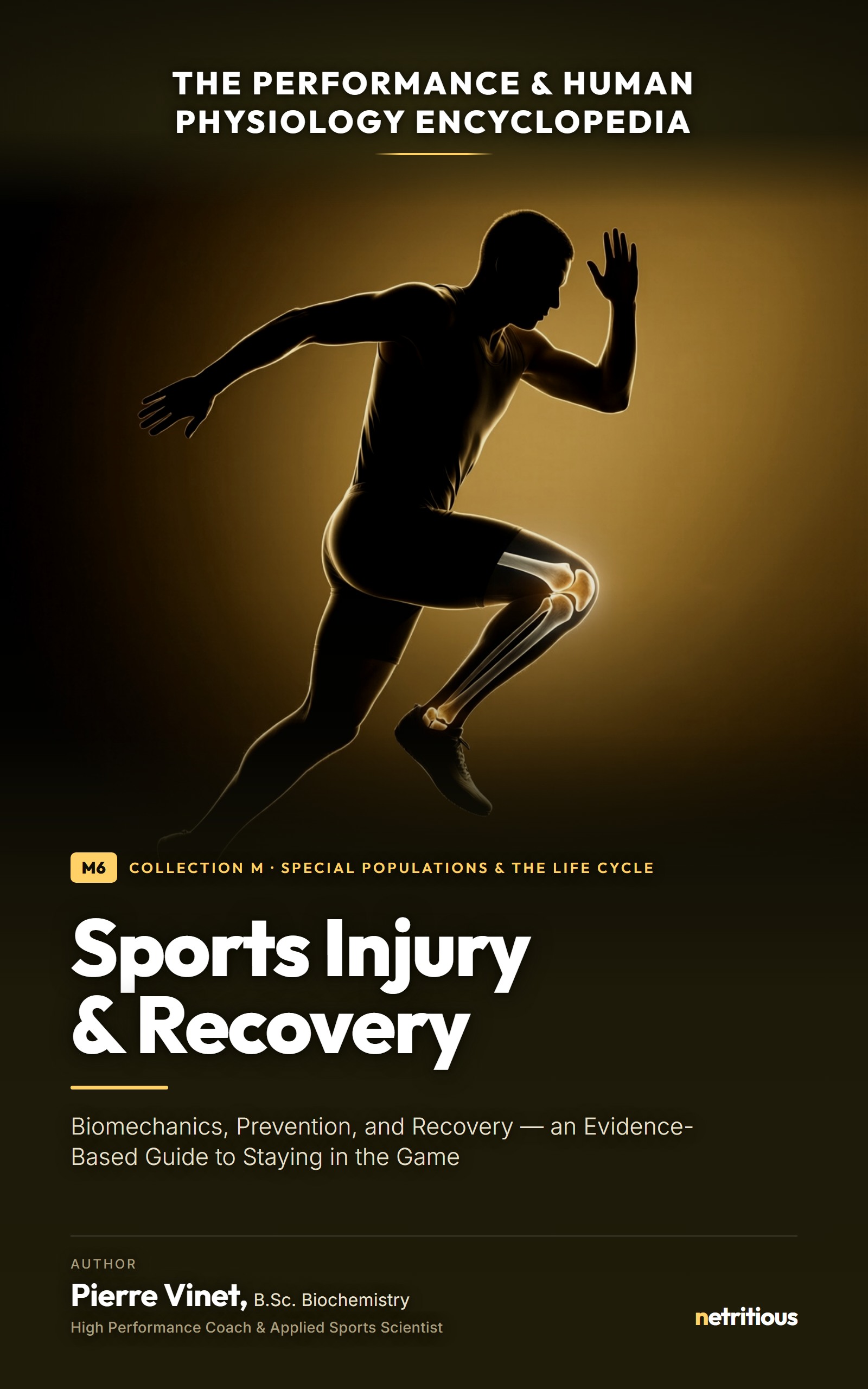
Sports Injury & Recovery
Biomechanics, Prevention, and Recovery — an Evidence-Based Guide to Staying in the Game
About this volume
Sports Injury & Recovery is Book M6 of The Performance & Human Physiology Encyclopedia — a 93-volume, university-level library on how training and nutrition must change for a specific population. It is written for coaches and clinicians serving women, youth, older adults and clinical populations: deep enough that a professional already trained in the field keeps learning, structured clearly enough that a motivated reader can follow every step.
How this book is written
- University level, without dilution. Exact scientific terminology, defined at first use — mechanisms, not just conclusions.
- Myths tested against the evidence. Where a popular claim does not survive the evidence, the book says so — and shows why.
- References at the end of every chapter. Sources cited in APA 7 style, plus a master bibliography.
For general information and education only; not medical advice. Consult a qualified health professional before acting on its content.
Read an excerpt
From Chapter 1 — Sports Injuries: Why They Happen
"A sprained ankle, a torn hamstring, an inflamed Achilles — we tend to treat these as bad luck, as random misfortunes that strike out of nowhere. They are not. Almost every sports injury follows the same simple logic: a tissue was asked to handle more load than it could, on that day or over time. Once you see injury as load versus capacity, two things follow — most injuries become substantially preventable, and recovery becomes an active, trainable process rather than a passive wait."
Injuries are the great interrupter of sport and active life — costing performance, time, money, and sometimes long-term health. Yet they are surrounded by myth and outdated practice: that they are random bad luck, that rest is the best medicine, that ice and passive treatments heal tissue, that stretching prevents injury, and that pain always means damage. This book replaces those ideas with an evidence-based understanding of why injuries happen, how to prevent them, and how recovery actually works.
This book is for everyone who moves — athletes, coaches, trainees, students, clinicians-in-training, and active people. It is inclusive and written at a university level while remaining friendly. Its companions in this library are B5/B6 (biomechanics; mobility and injury prevention); M6 is the biomechanics-and-principles book — it teaches how to think about injury, prevention, and recovery. A crucial boundary runs throughout: the diagnosis and treatment of specific injuries belong to qualified clinicians (Book N4); this book teaches the principles, not self-diagnosis or self-treatment.
What is inside
The 13 chapters of this volume.
- 01
Sports Injuries: Why They Happen
- 02
Tissue Mechanics and Mechanobiology
- 03
The Biomechanics of Injury
- 04
Acute vs Overuse Injuries
- 05
Load Management: The Master Variable
- 06
Injury Prevention That Works
- 07
Common Injuries: The Lower Limb
- 08
Common Injuries: Upper Limb, Spine, and More
- 09
Modern Rehabilitation Principles
- 10
Pain Science for Injury
- 11
Passive Modalities and Recovery Tools: The Honest Evidence
- 12
Return to Sport
- 13
An Evidence-Based Framework for Prevention and Recovery
Volume details
Topics covered
- tendinopathy tendon pain
- hamstring strain
- shin splints
- runner's knee
- return to play criteria
- rotator cuff shoulder pain
- ankle sprain rehab
Get this volume
This volume is in production. This page will carry the link the day it goes on sale.