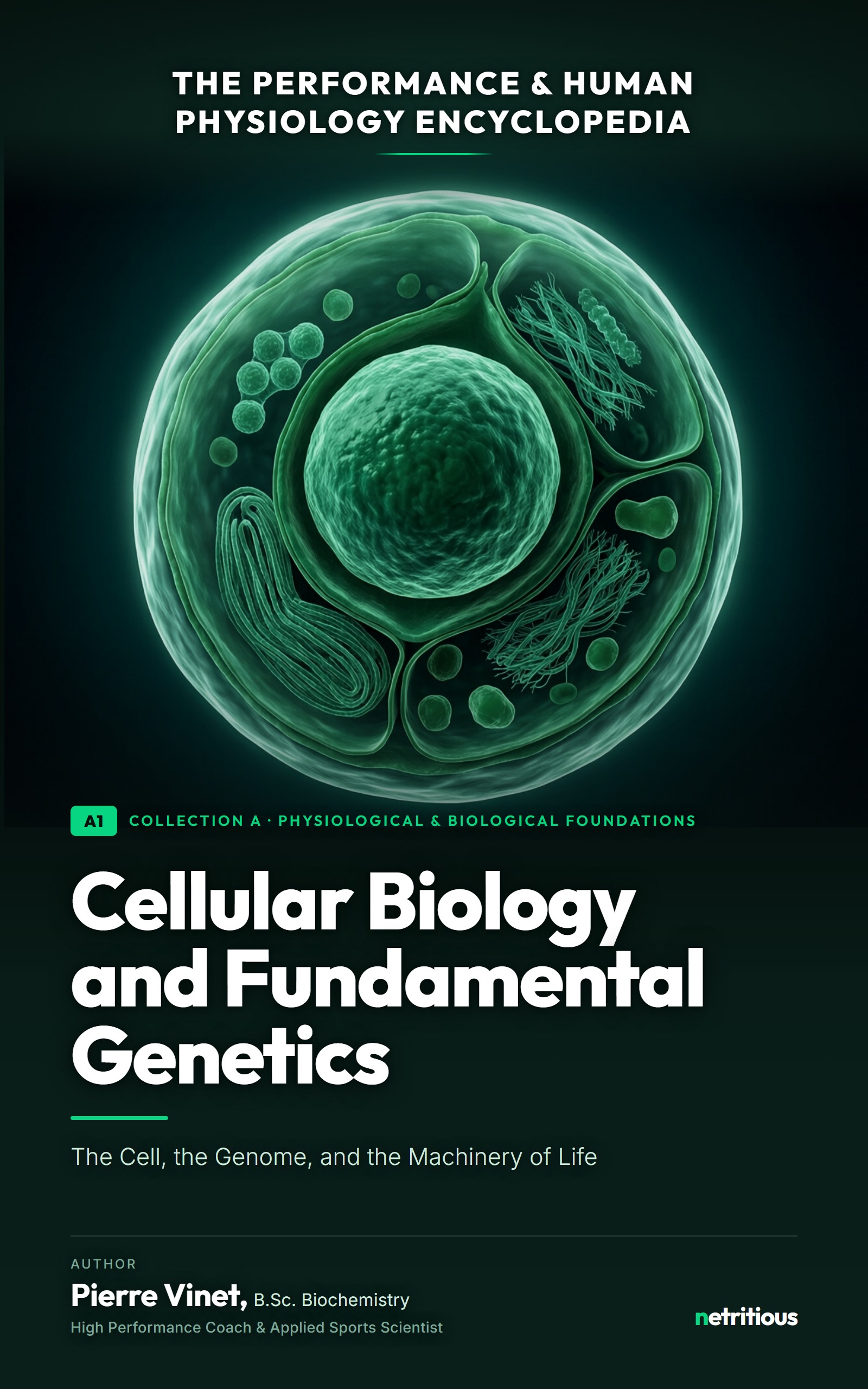
Cellular Biology and Fundamental Genetics
The Cell, the Genome, and the Machinery of Life
About this volume
Cellular Biology and Fundamental Genetics is Book A1 of The Performance & Human Physiology Encyclopedia — a 93-volume, university-level library on how the human body actually works, system by system. It is written for students, coaches, clinicians and serious self-learners: deep enough that a professional already trained in the field keeps learning, structured clearly enough that a motivated reader can follow every step.
How this book is written
- University level, without dilution. Exact scientific terminology, defined at first use — mechanisms, not just conclusions.
- Numbers, formulas, worked examples. Reference ranges, equations and solved calculations you can apply the same day.
- References at the end of every chapter. Sources cited in APA 7 style, plus a master bibliography.
For general information and education only; not medical advice. Consult a qualified health professional before acting on its content.
Read an excerpt
From Chapter 1 — The Cell as the Unit of Life: Cell Theory, Scale, and Cellular Diversity
"Every breath you take, every rep you lift, every meal you digest, every thought you think — all of it happens because some thirty-seven trillion cells are quietly doing their jobs. Understand the cell, and you have the key to understanding the whole body."
This is the first book of the Foundations collection, and the cell is where everything begins. The macronutrients of Book F2 are digested, absorbed, and burned by cells; the micronutrients of Book F3 work as coenzymes inside cells; the energy balance of Book F1 is the sum of cellular metabolism; muscle grows, bone remodels, hormones act, nerves fire, and fat is stored — all at the level of the cell. To understand why the body behaves as it does — why training builds muscle, why some people respond differently to the same diet, why aging changes the body, why disease arises — you must understand the cell and the genetic information that runs it. This chapter establishes what a cell is, how small it is and why, how cells differ, and how they assemble into the body. It is the conceptual ground floor of the entire library: master it, and every later book — physiology, training, nutrition, clinical health, longevity — rests on solid foundations. Whether you are a student, an athlete curious about how adaptation works, a coach, or a health professional, this is where the science of the body truly starts.
What is inside
The 13 chapters of this volume.
- 01
The Cell as the Unit of Life: Cell Theory, Scale, and Cellular Diversity
Cell theory, scale, SA:V, prokaryote/eukaryote, ~37 trillion cells
- 02
The Molecules of Life: Biochemistry of the Cell
Water, carbon, the four macromolecule classes, protein structure, bonds
- 03
The Plasma Membrane and Membrane Transport
Fluid mosaic, diffusion/osmosis, active transport, Na/K pump, membrane potential
- 04
Inside the Cell I: The Nucleus and the Endomembrane System
Nucleus, ER, ribosomes, Golgi, lysosomes, the secretory pathway
- 05
Inside the Cell II: Mitochondria, the Cytoskeleton, and Architecture
Mitochondria & endosymbiosis, biogenesis, cytoskeleton, motors, junctions/ECM
- 06
Enzymes and Cellular Metabolism
Catabolism/anabolism, activation energy, enzymes, kinetics, regulation, ATP
- 07
Cell Signaling and Communication
Signaling modes, receptors, second messengers, amplification, gene-level signaling
- 08
DNA, the Genome, and the Central Dogma
Double helix, base pairing, chromatin, karyotype, genome, central dogma
- 09
DNA Replication and Repair
Semiconservative replication, the fork, fidelity, telomeres, damage, mutations
- 10
From Gene to Protein: Transcription and Translation
Transcription, splicing, the genetic code, translation, folding
- 11
Gene Regulation and Epigenetics
Differential expression, transcription factors, methylation/histones, environment
- 12
The Cell Cycle, Mitosis, and Cell Death
Cell cycle, mitosis, checkpoints, cancer, apoptosis, stem cells, satellite cells
- 13
Inheritance and Fundamental Genetics: From Mendel to the Genome
Meiosis, variation, Mendel, Punnett squares, inheritance patterns, polygenic traits
Volume details
Topics covered
- DNA replication and repair
- protein synthesis transcription translation
- organelles and membrane transport explained
- gene regulation and epigenetics basics
- Mendel and inheritance patterns
- enzymes and signal transduction
- mitosis and apoptosis explained
Get this volume
This volume is in production. This page will carry the link the day it goes on sale.