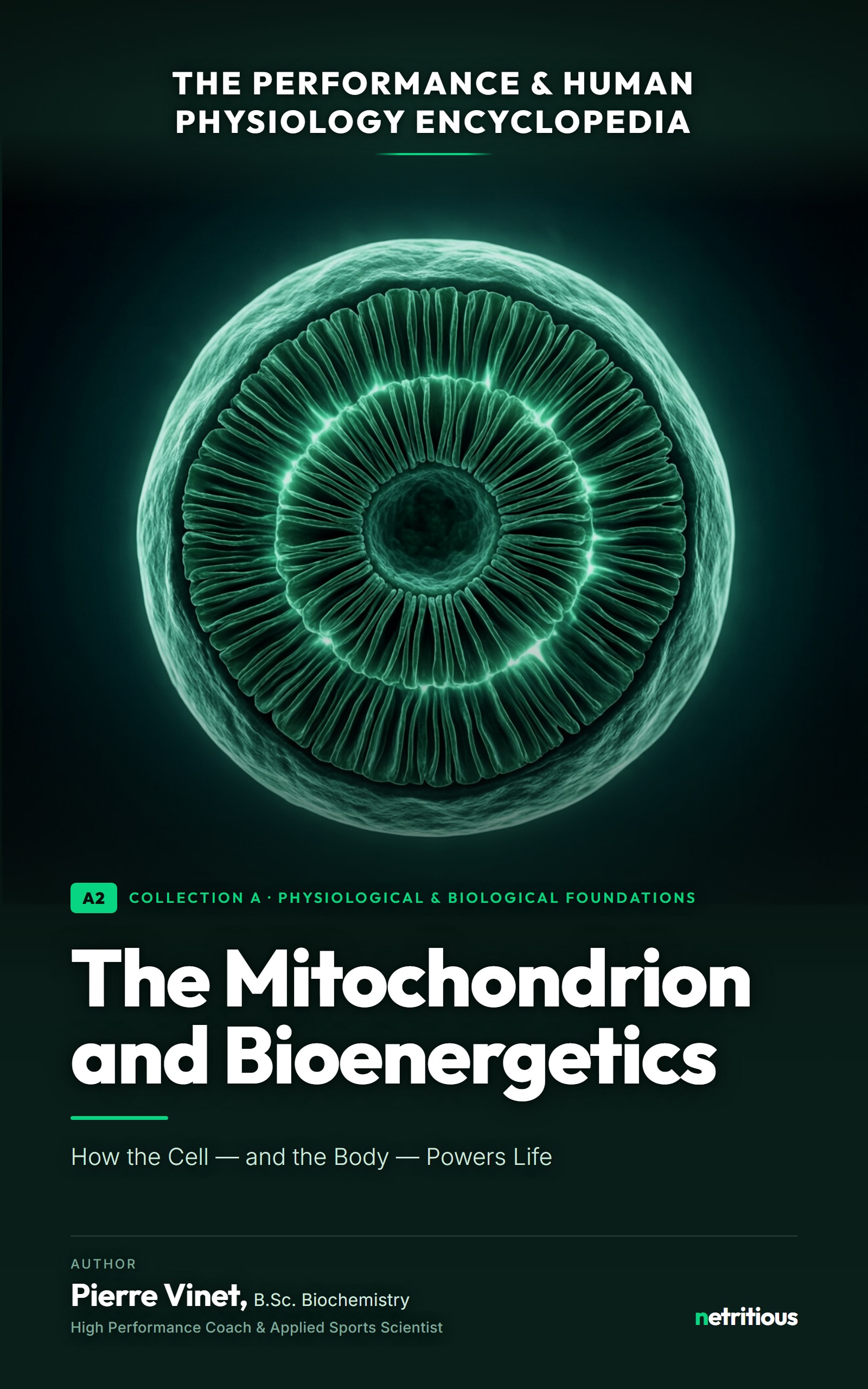
The Mitochondrion and Bioenergetics
How the Cell — and the Body — Powers Life
About this volume
The Mitochondrion and Bioenergetics is Book A2 of The Performance & Human Physiology Encyclopedia — a 93-volume, university-level library on how the human body actually works, system by system. It is written for students, coaches, clinicians and serious self-learners: deep enough that a professional already trained in the field keeps learning, structured clearly enough that a motivated reader can follow every step.
How this book is written
- University level, without dilution. Exact scientific terminology, defined at first use — mechanisms, not just conclusions.
- Evidence graded, not asserted. Major claims carry a level, from A (strong) to D (expert opinion), so you always know how much weight to give them.
- Numbers, formulas, worked examples. Reference ranges, equations and solved calculations you can apply the same day.
- Myths tested against the evidence. Where a popular claim does not survive the evidence, the book says so — and shows why.
- References at the end of every chapter. Sources cited in APA 7 style, plus a master bibliography.
For general information and education only; not medical advice. Consult a qualified health professional before acting on its content.
Read an excerpt
From Chapter 1 — Energy, Thermodynamics, and the Logic of Bioenergetics
"A living cell is a chemical factory that never closes, runs uphill for a living, and pays for every uphill step with a currency it must constantly re-earn. To understand how the body powers life, you must first understand the rules of that economy — the laws of energy."
Every process this book describes — burning glucose, building muscle protein, pumping ions across a membrane, contracting a fiber, even thinking — costs energy, and that energy obeys a small set of physical laws that never bend. Book F1 examined energy balance at the level of the whole body (calories in, calories out). This book goes inside the cell, to the molecular machinery that actually does the work, and it begins here, with the rules of the game. If you grasp why some reactions release energy and others require it, why the cell needs a rechargeable "energy currency" at all, and why oxidizing food yields usable power, then glycolysis, the citric acid cycle, oxidative phosphorylation, fat burning, and the energy systems of exercise will all make sense as variations on a single theme rather than lists to memorize. Whether you want to understand your own fatigue during a hard effort, why fat is a denser fuel than carbohydrate, how a cell "decides" to store or release energy, or simply how a meal becomes the power to move — it all starts with thermodynamics. This is the conceptual engine room of the entire book.
What is inside
The 13 chapters of this volume.
- 01
Energy, Thermodynamics, and the Logic of Bioenergetics
- 02
ATP: The Universal Energy Currency
- 03
The Mitochondrion: Structure, Origin, and Dynamics
- 04
Redox Chemistry and the Electron Carriers
- 05
Fuel Catabolism I: Glycolysis
- 06
Fuel Catabolism II: Pyruvate Oxidation and the Citric Acid Cycle
- 07
Oxidative Phosphorylation: The Electron Transport Chain and Chemiosmosis
- 08
Fatty Acid Oxidation and Ketone Metabolism
- 09
Amino Acid Oxidation and the Integration of Fuels
- 10
Anaerobic Energy and the Energy Systems of Exercise
- 11
Integration and Regulation of Whole-Body Energy Metabolism
- 12
Mitochondrial Adaptation, Reactive Oxygen Species, and Metabolic Health
- 13
Bioenergetics in Practice: Fueling, Performance, and Metabolic Health
Volume details
Topics covered
- ATP production explained
- electron transport chain and chemiosmosis
- glycolysis and Krebs cycle
- oxidative phosphorylation
- fat oxidation and ketone metabolism
- energy systems in exercise physiology
- reactive oxygen species and mitochondrial health
Get this volume
Available on Amazon as a Kindle ebook.