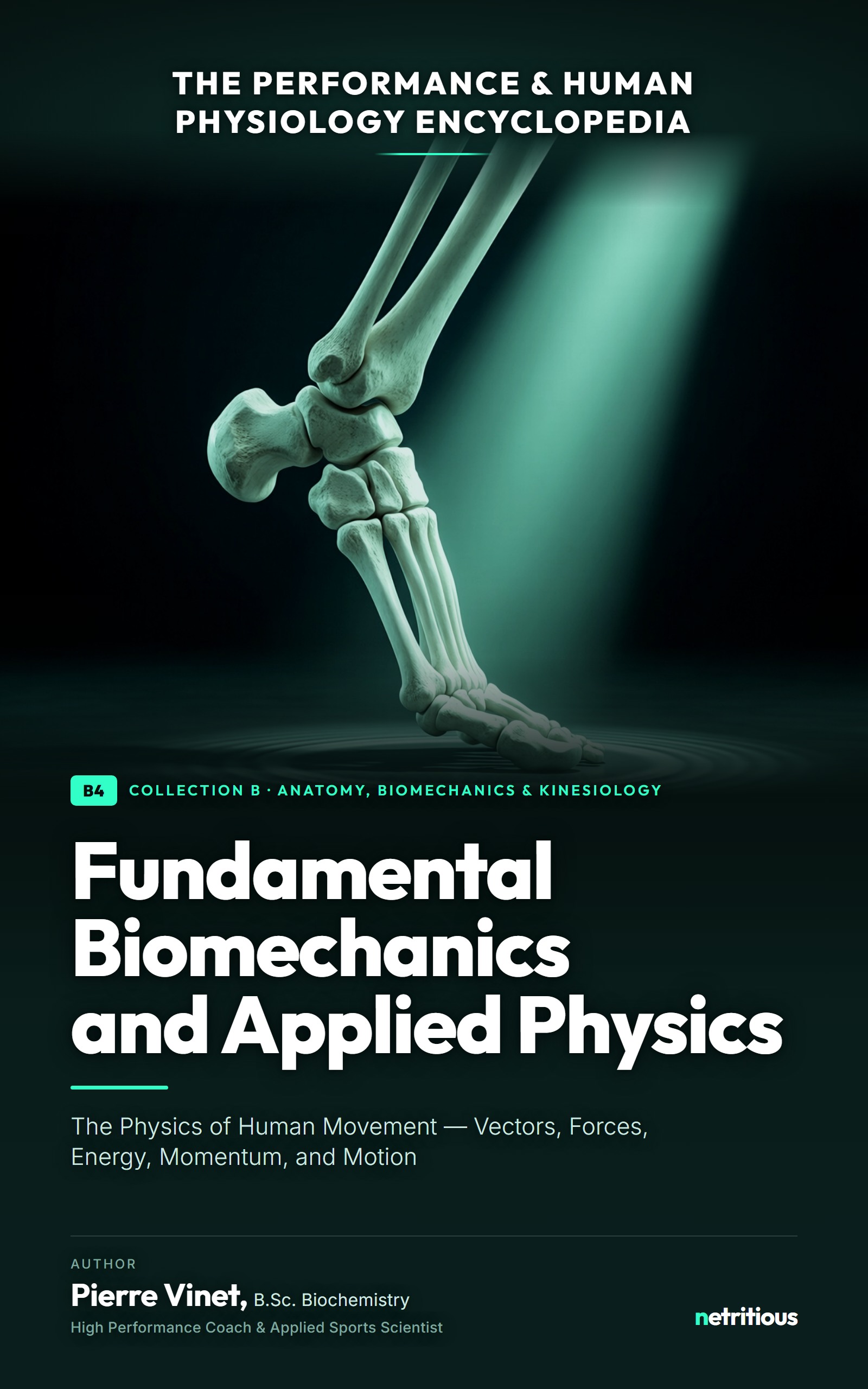
Fundamental Biomechanics and Applied Physics
The Physics of Human Movement — Vectors, Forces, Energy, Momentum, and Motion
About this volume
Fundamental Biomechanics and Applied Physics is Book B4 of The Performance & Human Physiology Encyclopedia — a 93-volume, university-level library on how the body produces, transmits and controls movement. It is written for coaches, strength athletes, physiotherapists and kinesiology students: deep enough that a professional already trained in the field keeps learning, structured clearly enough that a motivated reader can follow every step.
How this book is written
- University level, without dilution. Exact scientific terminology, defined at first use — mechanisms, not just conclusions.
- Numbers, formulas, worked examples. Reference ranges, equations and solved calculations you can apply the same day.
- Myths tested against the evidence. Where a popular claim does not survive the evidence, the book says so — and shows why.
- References at the end of every chapter. Sources cited in APA 7 style, plus a master bibliography.
For general information and education only; not medical advice. Consult a qualified health professional before acting on its content.
Read an excerpt
From Chapter 1 — Introduction to Biomechanics and the Language of Mechanics
"Every movement the body makes obeys the same laws that govern a thrown ball, a leaning ladder, or a spinning wheel. Biomechanics is simply physics applied to living things — and once you have its language, the body stops being a mystery of effort and feel and becomes a system you can measure, predict, and reason about. This chapter lays out that language: the branches of mechanics, the difference between a number and a vector, the units everything is measured in, and the simplifying models that make a body's bewildering complexity solvable."
This book supplies the general physics of movement that the rest of the curriculum draws on. Book B3 (Joint Mechanics and Kinesiology) deliberately took only the mechanics it needed for the joints and handed the underlying physics here; Book B5 will apply that physics to athletic skills. To get the most from those books — and to reason about force, speed, power, balance, and impact in your own training or coaching — you need the shared language of mechanics. This chapter builds that vocabulary and the mental map of how the pieces fit, so every later chapter has a place to hang. It also sets the tone: biomechanics is a quantitative discipline, and learning to put numbers on movement is its central skill.
What is inside
The 13 chapters of this volume.
- 01
Introduction to Biomechanics and the Language of Mechanics
- 02
Vectors and the Mathematics of Forces
- 03
Linear Kinematics
- 04
Projectile Motion
- 05
Linear Kinetics: Force and Newton's Laws
- 06
Friction and the Ground Reaction Force
- 07
Work, Power, and Energy
- 08
Impulse and Momentum
- 09
Angular Kinematics
- 10
Angular Kinetics: Torque, Moment of Inertia & Angular Momentum
- 11
Equilibrium, Center of Gravity, and Stability
- 12
Fluid Mechanics: Drag, Lift, and Buoyancy
- 13
Applied Biomechanics: Measurement and Quantitative Analysis
Volume details
Topics covered
- newton's laws human movement
- projectile motion sports
- torque moment of inertia athletes
- impulse momentum jumping landing
- ground reaction force friction
- kinesiology textbook for coaches
- quantitative movement analysis
Get this volume
This volume is in production. This page will carry the link the day it goes on sale.