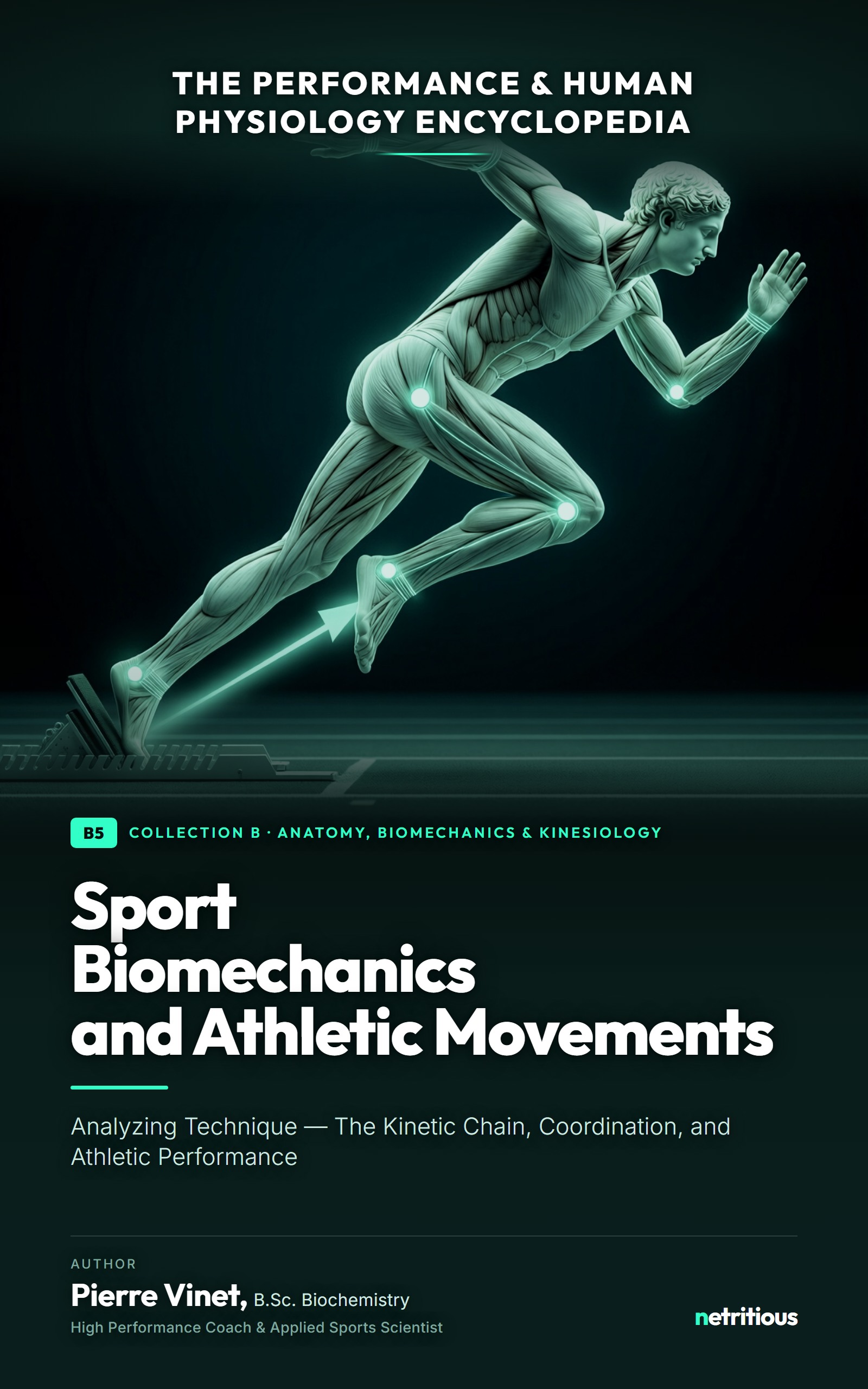
Sport Biomechanics and Athletic Movements
Analyzing Technique — The Kinetic Chain, Coordination, and Athletic Performance
About this volume
Sport Biomechanics and Athletic Movements is Book B5 of The Performance & Human Physiology Encyclopedia — a 93-volume, university-level library on how the body produces, transmits and controls movement. It is written for coaches, strength athletes, physiotherapists and kinesiology students: deep enough that a professional already trained in the field keeps learning, structured clearly enough that a motivated reader can follow every step.
How this book is written
- University level, without dilution. Exact scientific terminology, defined at first use — mechanisms, not just conclusions.
- Numbers, formulas, worked examples. Reference ranges, equations and solved calculations you can apply the same day.
- Myths tested against the evidence. Where a popular claim does not survive the evidence, the book says so — and shows why.
- References at the end of every chapter. Sources cited in APA 7 style, plus a master bibliography.
For general information and education only; not medical advice. Consult a qualified health professional before acting on its content.
Read an excerpt
From Chapter 1 — Introduction to Sport Biomechanics
"A coach watches a sprinter and sees 'more drive'; a biomechanist watches the same sprinter and sees ground forces, segment sequencing, and the impulse that builds velocity. Sport biomechanics is the discipline that turns the first kind of seeing into the second — that takes the physics of movement and uses it to understand, analyze, and improve the way athletes actually move. This chapter sets up what the field is, what it is for, and the framework the rest of the book uses to analyze any skill."
Every coach, athlete, and clinician makes biomechanical judgments — "fix that knee," "use your legs," "stay tall" — whether or not they call them that. Sport biomechanics makes those judgments principled instead of intuitive: it explains why a technique works, what limits a performance, and how to change movement to perform better and get hurt less. This book is where the physics of Books B3 and B4 becomes a practical method for analyzing real athletic movement. This opening chapter builds the map — the aims, the vocabulary, and the analytical framework — that organizes everything that follows.
What is inside
The 13 chapters of this volume.
- 01
Introduction to Sport Biomechanics
- 02
Principles of Biomechanical Analysis
- 03
Qualitative Movement Analysis
- 04
The Kinetic Chain and Summation of Speed
- 05
Force, Power, and Force-Time Strategies in Sport
- 06
Balance, Stability, and Agility (Change of Direction)
- 07
Sprinting and Running Mechanics
- 08
Jumping Mechanics
- 09
Throwing and Striking
- 10
Cyclical and Aquatic Sports
- 11
Biomechanics of Strength and Explosive Lifting
- 12
Technique, Injury, and Individual Optimization
- 13
Applied Sport Biomechanics
Volume details
Topics covered
- sprinting jumping throwing mechanics
- swimming cycling aerodynamics drag
- force time curve impulse explained
- ACL cutting landing injury mechanics
- sports science textbook for coaches
- how to analyze running gait and stride
- weightlifting bar path and lifting leverage
Get this volume
This volume is in production. This page will carry the link the day it goes on sale.