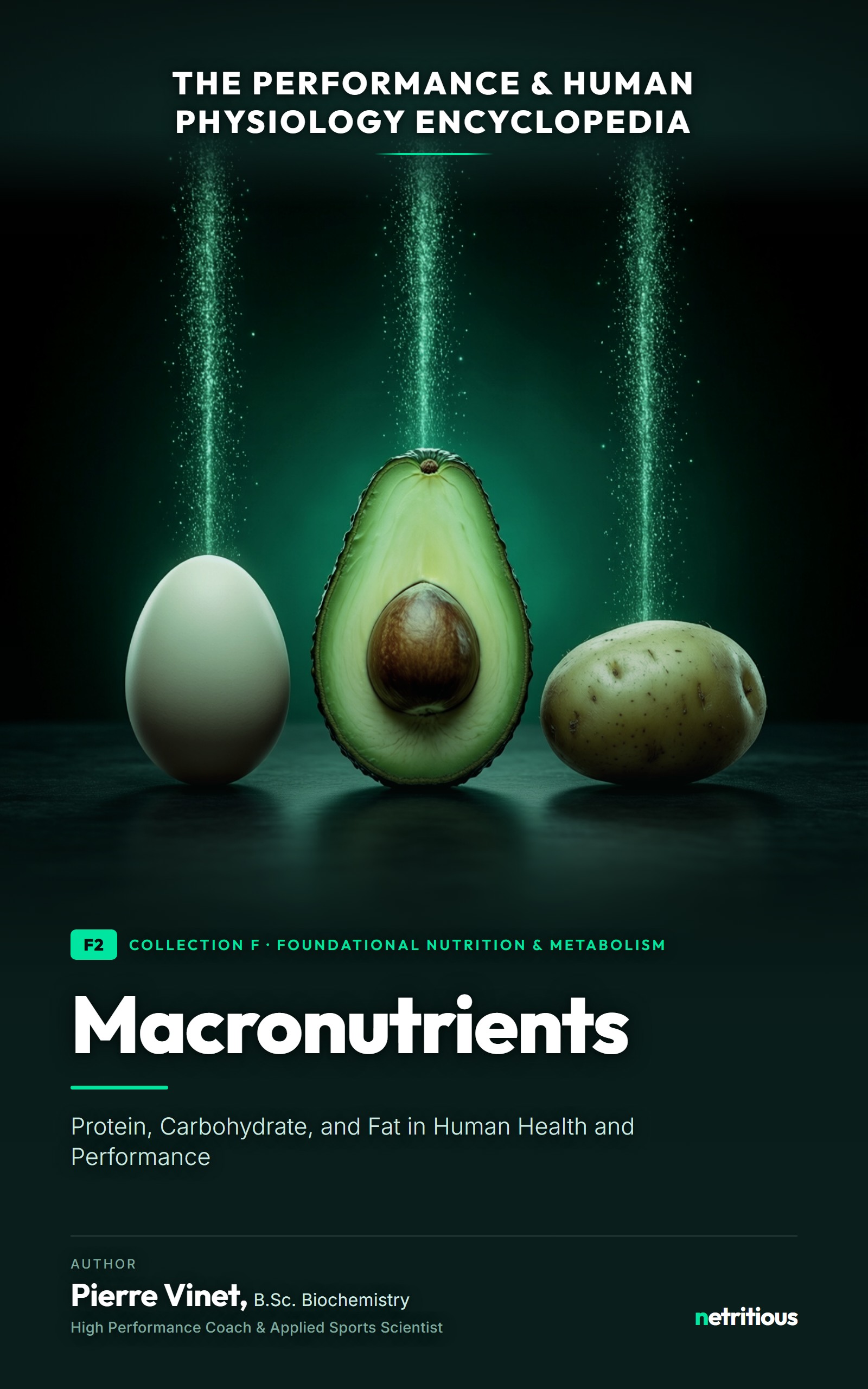
Macronutrients
Protein, Carbohydrate, and Fat in Human Health and Performance
About this volume
Macronutrients is Book F2 of The Performance & Human Physiology Encyclopedia — a 93-volume, university-level library on the metabolic first principles every nutrition decision rests on. It is written for dietitians, nutrition students, coaches and anyone managing their own body: deep enough that a professional already trained in the field keeps learning, structured clearly enough that a motivated reader can follow every step.
How this book is written
- University level, without dilution. Exact scientific terminology, defined at first use — mechanisms, not just conclusions.
- Numbers, formulas, worked examples. Reference ranges, equations and solved calculations you can apply the same day.
- Myths tested against the evidence. Where a popular claim does not survive the evidence, the book says so — and shows why.
- References at the end of every chapter. Sources cited in APA 7 style, plus a master bibliography.
For general information and education only; not medical advice. Consult a qualified health professional before acting on its content.
Read an excerpt
From Chapter 1 — What Macronutrients Are: Energy, Essentiality, and the Reference Intakes
"Everything you have ever built, burned, or stored began as one of three molecules on a plate."
Energy balance (the subject of Book F1) tells you how much to eat; it is silent on what that food is made of. Yet two diets identical in calories can build muscle or waste it, stabilize blood sugar or spike it, protect the heart or strain it — because they differ in their macronutrients. The three macronutrients are simultaneously the body's fuel, its construction material, and a set of signals that direct metabolism. Before you can reason about protein for muscle, carbohydrate for performance, or fat for health, you need a precise, shared vocabulary: what these molecules are, how much energy they carry, which parts of them your body cannot make for itself, and how official bodies translate all of this into numbers you can act on. This first chapter builds that foundation. Everything in the twelve chapters that follow rests on it.
What is inside
The 13 chapters of this volume.
- 01
What Macronutrients Are: Energy, Essentiality, and the Reference Intakes
Definitions, Atwater energy, essentiality, DRIs & AMDRs, nutrient density
- 02
Protein I: Amino Acids, Structure, and Protein Quality
Amino acids, protein structure, nitrogen, BV/PER/PDCAAS/DIAAS, animal vs plant
- 03
Protein II: Digestion, Absorption, and Metabolism
Proteolysis, the amino-acid pool, turnover, MPS/leucine, nitrogen balance, urea cycle
- 04
Protein III: Requirements, Optimization, and Safety
RDA vs optimum, 1.6–2.2 g/kg, distribution, deficit, aging, satiety, kidney/bone safety
- 05
Carbohydrates I: Classification, Structure, and Food Sources
Sugars→starch→fiber, glycosidic bonds, free vs added sugars, whole vs refined, GI/GL
- 06
Carbohydrates II: Digestion, Absorption, and Metabolism
Amylase, SGLT1/GLUT, insulin/glucagon, glycogen, glycolysis, fructose, gluconeogenesis, DNL
- 07
Carbohydrates III: Glycemic Response, Health, and Performance
GI/GL applied, fiber & health, added sugars, carbohydrate for performance, low-carb
- 08
Fats I: Lipid Classification, Fatty Acids, and Structure
Chain length, saturation, omega system, essential fatty acids, cis/trans, triglycerides, sterols
- 09
Fats II: Digestion, Absorption, Transport, and Metabolism
Bile/micelles, chylomicrons, lipoproteins, lipolysis, β-oxidation, ketogenesis
- 10
Fats III: Dietary Fat, Health, and Application
Replacement principle, saturated fat & CVD, Mediterranean, omega-3, seed-oil debate, fat floor
- 11
Alcohol, Fiber, and the Non-Standard Energy Contributors
Alcohol metabolism & body comp, fiber as energy/"net carbs", polyols, sweeteners, water
- 12
Macronutrient Interactions, Partitioning, and Metabolic Flexibility
Interconversions, oxidation hierarchy, protein sparing, Randle cycle, p-ratio, flexibility
- 13
Setting Macronutrient Targets: Ratios, Diets, and Putting It All Together
The 4-step method, targets by goal, diet comparison, IIFYM, case studies, durable principles
Volume details
Topics covered
- amino acids and nutrition science
- glycemic index and glycemic load
- omega-3 and saturated fat evidence
- flexible dieting and calorie targets
- sports nutrition textbook for coaches
- dietary fiber and alcohol calories
- daily gram targets by goal
Get this volume
This volume is in production. This page will carry the link the day it goes on sale.