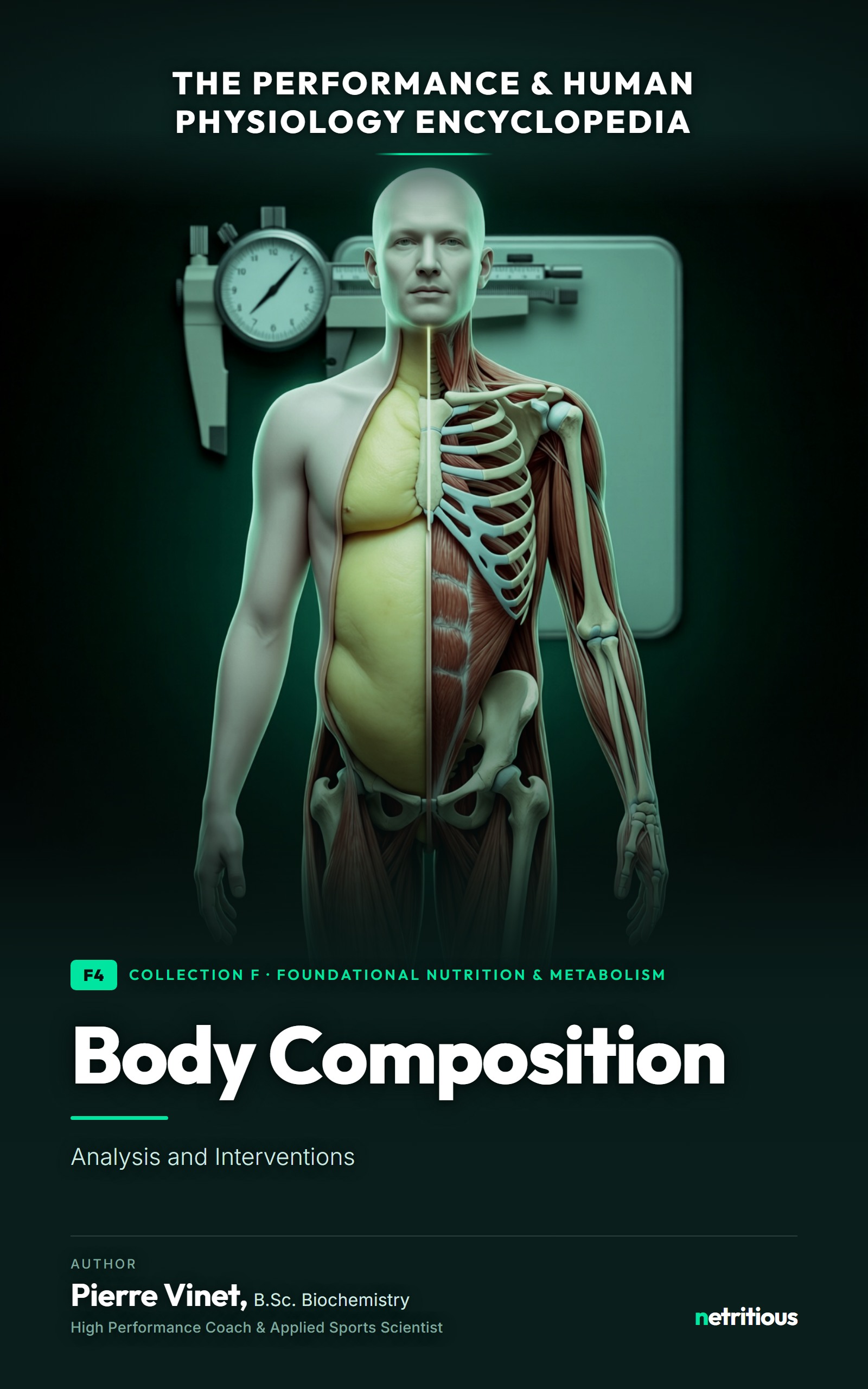
Body Composition
Analysis and Interventions
About this volume
Body Composition is Book F4 of The Performance & Human Physiology Encyclopedia — a 93-volume, university-level library on the metabolic first principles every nutrition decision rests on. It is written for dietitians, nutrition students, coaches and anyone managing their own body: deep enough that a professional already trained in the field keeps learning, structured clearly enough that a motivated reader can follow every step.
How this book is written
- University level, without dilution. Exact scientific terminology, defined at first use — mechanisms, not just conclusions.
- Numbers, formulas, worked examples. Reference ranges, equations and solved calculations you can apply the same day.
- Myths tested against the evidence. Where a popular claim does not survive the evidence, the book says so — and shows why.
- References at the end of every chapter. Sources cited in APA 7 style, plus a master bibliography.
For general information and education only; not medical advice. Consult a qualified health professional before acting on its content.
Read an excerpt
From Chapter 1 — What Body Composition Is: Compartments, Models, and Why Weight Isn't Enough
"The scale tells you how much of you there is. It says nothing about what you are made of — and almost everything that matters for health and performance lives in that difference."
Two people can weigh exactly the same and be physiologically worlds apart: one carrying 12 kg of fat over a large, dense muscular and skeletal frame, the other carrying 30 kg of fat over little muscle and thin bone. The bathroom scale — and even the body mass index calculated from it — cannot tell them apart, yet their risk of diabetes, their strength, their metabolic rate, their power-to-weight ratio, and their response to training differ enormously. Body composition is the study of what the body is actually made of, and it is the missing variable that turns "how much do you weigh?" into "what is your weight made of, and is that healthy and functional?" This book is about measuring that composition accurately, interpreting it sensibly, and changing it deliberately. This first chapter builds the conceptual scaffold — the compartments and models — on which every later chapter (every measurement method, every reference range, every intervention) is built. Whether you are tracking your own physique, coaching an athlete, counseling a patient, or studying the science, you cannot use a body-fat number wisely until you understand what kind of number it is.
What is inside
The 13 chapters of this volume.
- 01
What Body Composition Is: Compartments, Models, and Why Weight Isn't Enough
FM/FFM, the 2C–4C models, Wang's five levels, density assumptions
- 02
Adipose Tissue and Body Fat
Adipocytes, white/brown fat, depots, adipokines, distribution, growth
- 03
Fat-Free Mass: Skeletal Muscle, Bone, Water, and Protein
TBW & the hydration constant, muscle, bone, body cell mass, FFM density
- 04
The Science of Measurement: Validity, Reliability, and the Criterion Problem
Accuracy vs precision, SEE, smallest detectable change, the 4C criterion
- 05
Anthropometry: BMI, Circumferences, Ratios, and Skinfolds
BMI, waist/WHtR, skinfold equations, the field battery
- 06
Densitometry: Hydrodensitometry and Air-Displacement Plethysmography
Density → fat, residual/thoracic gas volume, the 2C assumption
- 07
DXA: Dual-Energy X-ray Absorptiometry
3-compartment regional output, VAT/ALMI, dose, standardization
- 08
Bioelectrical Impedance and Field Methods
Impedance index, phase angle, hydration sensitivity, ultrasound/3-D/NIR
- 09
Imaging and Laboratory Reference Methods
MRI/CT, dilution, total body potassium, neutron activation, the 4C model
- 10
Interpreting Results: Reference Ranges, Body-Fat Standards, and Indices
Healthy ranges, athlete norms, FFMI/FMI, the U-curve, RED-S
- 11
Body Composition, Health, and Performance
Visceral fat & metabolic syndrome, sarcopenia, bone, power-to-weight
- 12
Changing Body Composition: Fat Loss, Muscle Gain, and Recomposition
Partitioning, protein + lifting, rates, plateaus, recomposition
- 13
Measuring, Tracking, and Putting It All Together
Standardization, SDC, triangulation, special populations, the F1–F4 synthesis
Volume details
Topics covered
- dexa scan results explained
- bioelectrical impedance scale accuracy
- skinfold caliper technique
- underwater weighing densitometry
- waist to height ratio health
- lean mass index ffmi
- bmi limitations for athletes
Get this volume
This volume is in production. This page will carry the link the day it goes on sale.