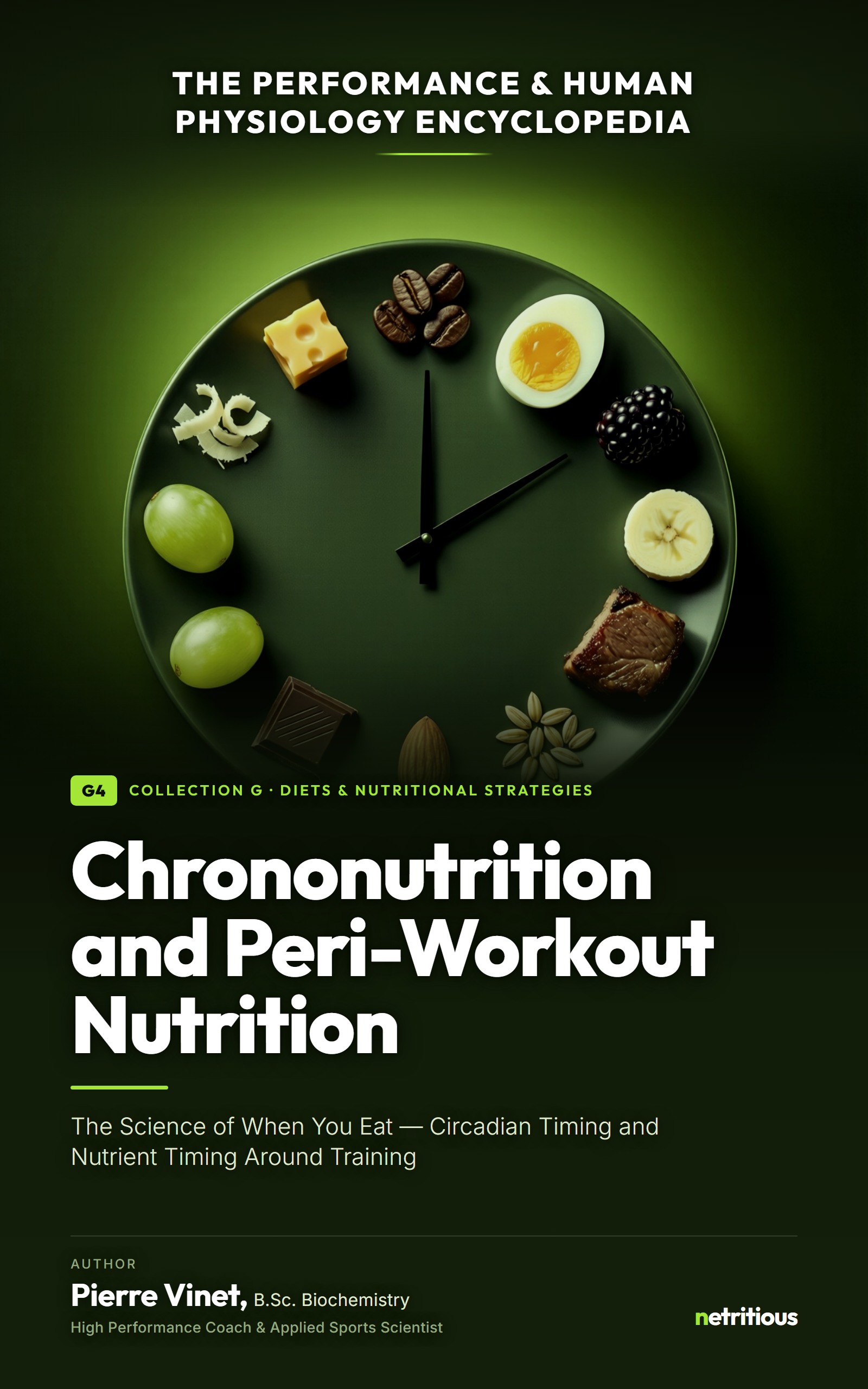
Chrononutrition and Peri-Workout Nutrition
The Science of When You Eat — Circadian Timing and Nutrient Timing Around Training
About this volume
Chrononutrition and Peri-Workout Nutrition is Book G4 of The Performance & Human Physiology Encyclopedia — a 93-volume, university-level library on what a given way of eating really does — and for whom. It is written for readers choosing a diet, and professionals asked about them daily: deep enough that a professional already trained in the field keeps learning, structured clearly enough that a motivated reader can follow every step.
How this book is written
- University level, without dilution. Exact scientific terminology, defined at first use — mechanisms, not just conclusions.
- Evidence graded, not asserted. Major claims carry a level, from A (strong) to D (expert opinion), so you always know how much weight to give them.
- Numbers, formulas, worked examples. Reference ranges, equations and solved calculations you can apply the same day.
- Myths tested against the evidence. Where a popular claim does not survive the evidence, the book says so — and shows why.
- References at the end of every chapter. Sources cited in APA 7 style, plus a master bibliography.
For general information and education only; not medical advice. Consult a qualified health professional before acting on its content.
Read an excerpt
From Chapter 1 — What Chrononutrition and Nutrient Timing Are (and Aren't)
"After what you eat and whether you eat, comes the most over-sold question in nutrition: when. When in the day should the calories fall? When, relative to your workout, should the protein and carbs arrive? An entire industry was built on the answer 'within a narrow magic window or your results evaporate.' The truth is quieter and more useful: timing is a real lever, but a secondary one — it fine-tunes a result that total intake has already decided. This book tells you exactly when timing matters, when it doesn't, and how to use it without being fooled."
"When should I eat?" is one of the most common — and most exploited — questions in nutrition. Believing the hype (that there is a 30-minute anabolic window, that you must eat six small meals to "stoke your metabolism," that carbs at night make you fat) wastes effort, money, and worry on details that rarely move the needle — and distracts from the few things that do. Understanding the real role of timing lets you ignore the noise, apply timing where it genuinely helps (high training frequency, endurance fueling, protein distribution, circadian alignment), and reassure yourself that the fundamentals — how much and what you eat — are where the results live. Whether you train seriously or just want to eat well, this chapter sets the honest frame for everything that follows. It builds directly on Book G3 (Chapter 4, circadian biology) and Books F1–F2 (energy balance, macronutrients).
What is inside
The 13 chapters of this volume.
- 01
What Chrononutrition and Nutrient Timing Are (and Aren't)
- 02
Circadian Rhythms and the Biology of "When"
- 03
Meal Frequency and Distribution
- 04
Chrononutrition: Eating in Sync With the Clock
- 05
The Pre-Exercise Window: Fueling for Performance
- 06
During Exercise: Intra-Workout Nutrition
- 07
The Post-Exercise Window and the "Anabolic Window" Myth
- 08
Protein Timing and Muscle Protein Synthesis
- 09
Carbohydrate Timing and Periodization
- 10
Hydration and Electrolyte Timing
- 11
Special Contexts: Two-a-Days, Endurance Events, Body Composition Goals
- 12
Sorting Hype From Evidence: Supplements, Fads, and the Timing Industry
- 13
Putting It Into Practice: An Evidence-Based Timing Framework
Volume details
Topics covered
- anabolic window protein after lifting
- meal before exercise for performance
- post exercise recovery glycogen refueling
- carb loading for marathon glycogen
- hydration electrolytes sodium endurance
- eating late at night body weight
- breakfast skipping meal frequency metabolism
Get this volume
Available on Amazon as a Kindle ebook.