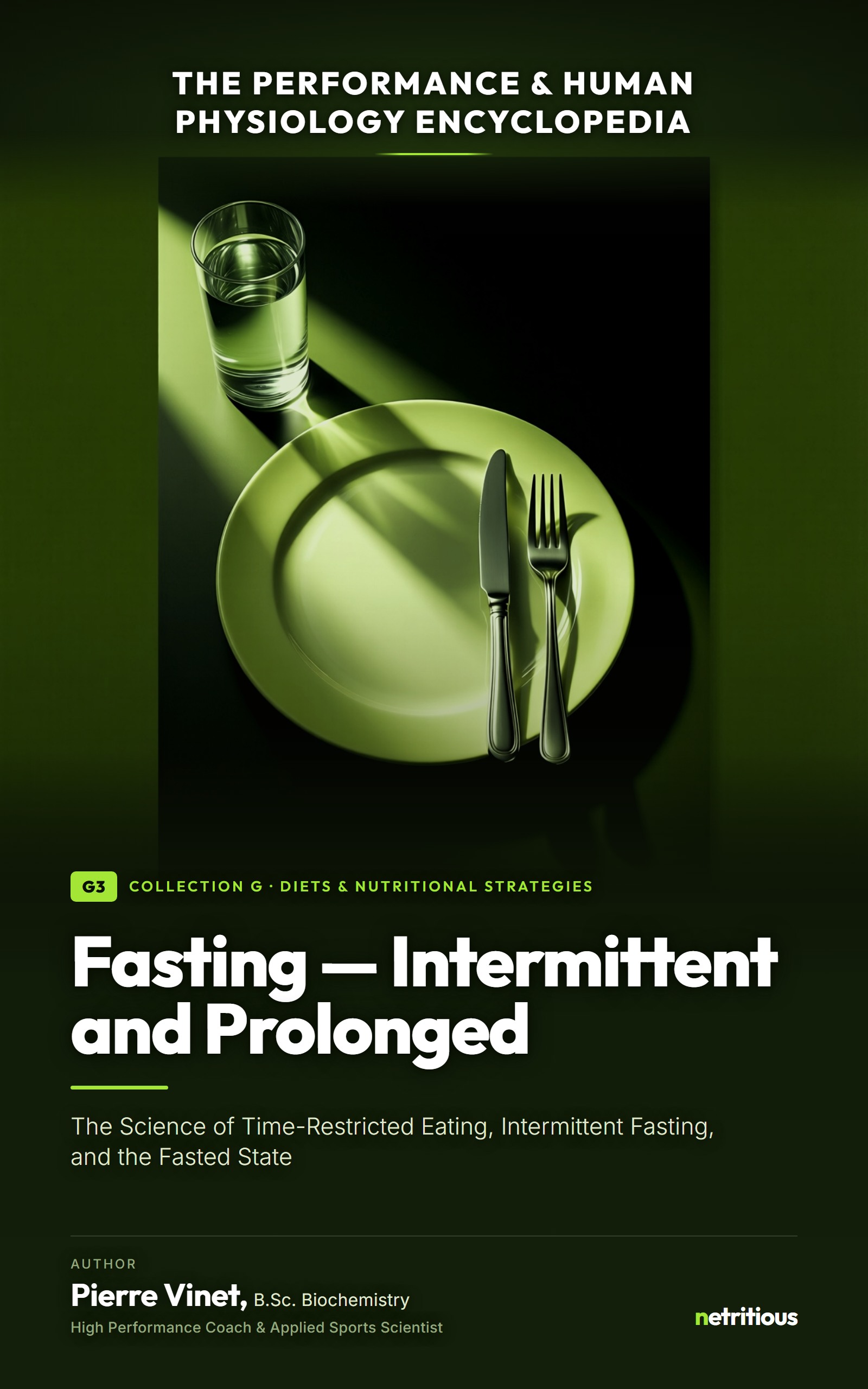
Fasting — Intermittent and Prolonged
The Science of Time-Restricted Eating, Intermittent Fasting, and the Fasted State
About this volume
Fasting — Intermittent and Prolonged is Book G3 of The Performance & Human Physiology Encyclopedia — a 93-volume, university-level library on what a given way of eating really does — and for whom. It is written for readers choosing a diet, and professionals asked about them daily: deep enough that a professional already trained in the field keeps learning, structured clearly enough that a motivated reader can follow every step.
How this book is written
- University level, without dilution. Exact scientific terminology, defined at first use — mechanisms, not just conclusions.
- Evidence graded, not asserted. Major claims carry a level, from A (strong) to D (expert opinion), so you always know how much weight to give them.
- Numbers, formulas, worked examples. Reference ranges, equations and solved calculations you can apply the same day.
- Myths tested against the evidence. Where a popular claim does not survive the evidence, the book says so — and shows why.
- References at the end of every chapter. Sources cited in APA 7 style, plus a master bibliography.
For general information and education only; not medical advice. Consult a qualified health professional before acting on its content.
Read an excerpt
From Chapter 1 — What Fasting Is (and Isn't)
"Fasting is the oldest dietary intervention in human history — older than agriculture, woven into every major religion, and practiced by every animal that has ever missed a meal. It is also, right now, one of the most over-promised ideas in nutrition. Somewhere between 'fasting is a miracle that melts fat, reverses aging, and cleans your cells' and 'fasting is just skipping breakfast and starving your muscles away' lies the truth — and the truth is genuinely interesting. This book holds both halves at once: fasting triggers real, ancient, well-described physiology, and most of its real-world benefits reduce to an old, unglamorous principle — eating less. We start by saying exactly what fasting is, what it isn't, and why it does what it does."
Fasting has moved from the fringe to the mainstream of nutrition conversation, and with that move has come a flood of confident, contradictory claims. Understanding what fasting actually is — a defined metabolic state reached by withholding energy, governed by hormones and fuel stores you can name and quantify — lets you separate the real physiology from the marketing. It lets you reason about whether a 16-hour eating window, a 5:2 pattern, or a supervised multi-day fast might serve your goals, whether those are fat loss, blood-glucose control (Book I2), metabolic health, athletic performance, or simply a simpler way to eat. And if you guide others, it equips you to give calm, accurate advice in a field crowded with both true believers and dismissive skeptics — including knowing the people for whom fasting is unwise or unsafe (Chapter 11). This opening chapter lays the groundwork: the definitions, the spectrum, the brief mechanism, and the honest framing on which the rest of the book is built.
What is inside
The 13 chapters of this volume.
- 01
What Fasting Is (and Isn't)
- 02
The Metabolic Phases of a Fast
- 03
Hormonal and Cellular Responses to Fasting
- 04
Time-Restricted Eating and Circadian Biology
- 05
Intermittent Fasting Protocols
- 06
Prolonged and Therapeutic Fasting
- 07
Fasting, Body Composition, and Weight Loss
- 08
Fasting and Metabolic Health
- 09
Fasting, Longevity, and Disease
- 10
Fasting and Physical Performance
- 11
Risks, Side Effects, and Contraindications
- 12
Sustainability, Adherence, and the Real-World Picture
- 13
Putting It Into Practice: An Evidence-Based Guide
Volume details
Topics covered
- 16:8 and 5:2 protocols
- alternate day calorie restriction
- refeeding syndrome risks
- water fast electrolytes
- circadian meal timing
- autophagy evidence review
- ketosis metabolic switch
Get this volume
Available on Amazon as a Kindle ebook.