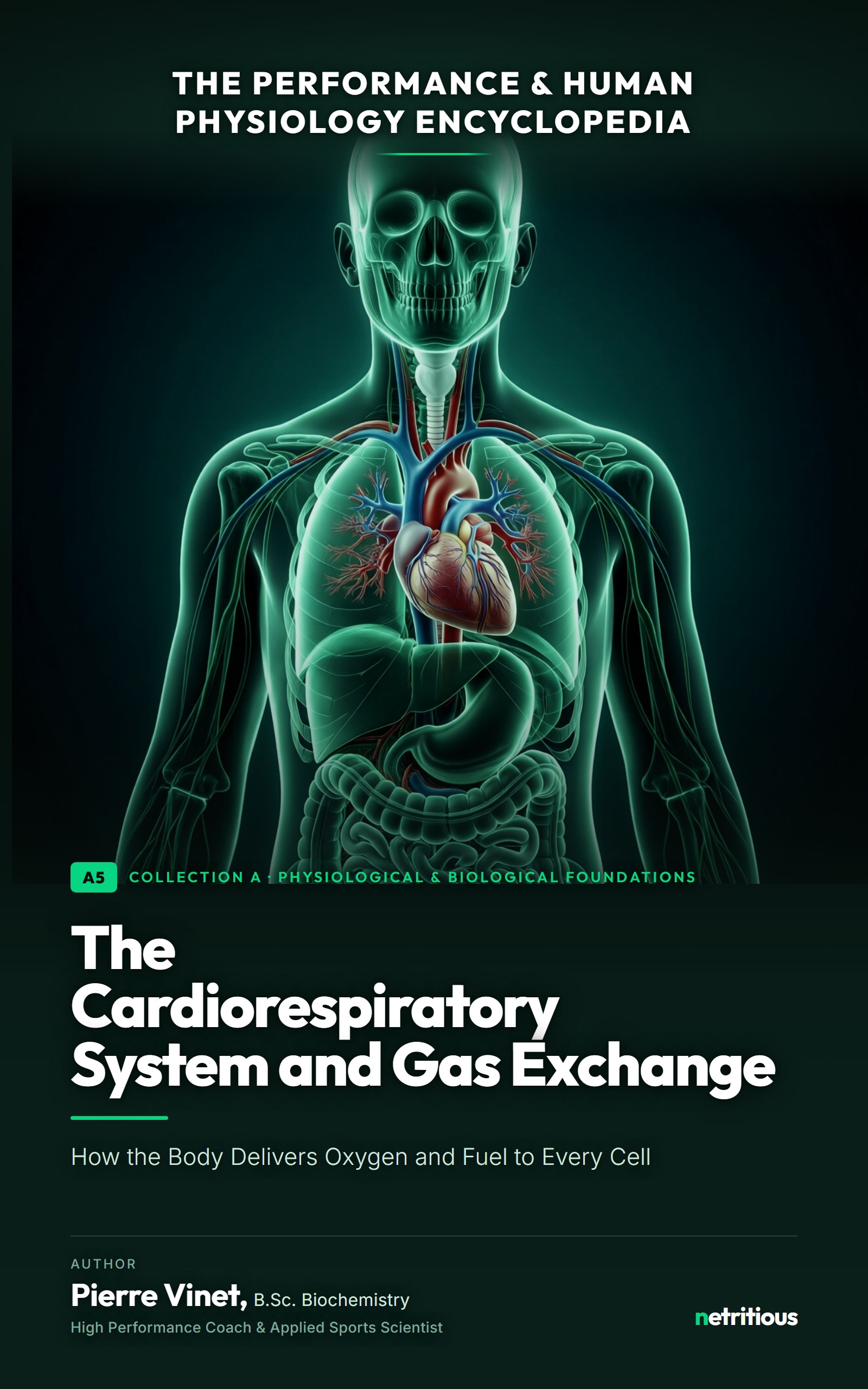
The Cardiorespiratory System and Gas Exchange
How the Body Delivers Oxygen and Fuel to Every Cell
About this volume
The Cardiorespiratory System and Gas Exchange is Book A5 of The Performance & Human Physiology Encyclopedia — a 93-volume, university-level library on how the human body actually works, system by system. It is written for students, coaches, clinicians and serious self-learners: deep enough that a professional already trained in the field keeps learning, structured clearly enough that a motivated reader can follow every step.
How this book is written
- University level, without dilution. Exact scientific terminology, defined at first use — mechanisms, not just conclusions.
- Numbers, formulas, worked examples. Reference ranges, equations and solved calculations you can apply the same day.
- References at the end of every chapter. Sources cited in APA 7 style, plus a master bibliography.
For general information and education only; not medical advice. Consult a qualified health professional before acting on its content.
Read an excerpt
From Chapter 1 — The Cardiorespiratory System: Organization and the Logic of Delivery
"A single cell can take what it needs straight from the water around it. You cannot. Tens of trillions of cells, some more than a meter from the nearest lung, all demand oxygen and fuel every second and produce waste that must be carried off. The cardiorespiratory system is the answer to a problem of distance — the body's circulatory freight network, pumping a river of blood past every cell, billions of times over a lifetime."
Every chapter of the Foundations collection has been building to this one. Book A2 showed that cells make energy by aerobic metabolism, which consumes oxygen and produces carbon dioxide. Book A4 showed how the gut absorbs nutrients. But oxygen enters only at the lungs, and nutrients only at the gut — while the cells that need them are spread throughout a large body, some far from any exchange surface. The cardiorespiratory system solves this problem of distance: it is the body's delivery network, carrying oxygen and fuel to every cell and carrying away carbon dioxide and waste. It is why you can be more than a thin film of cells. Understanding it explains the most fundamental measures of fitness and health: VO₂max (the ceiling on aerobic power and one of the strongest predictors of longevity), blood pressure (the silent killer when too high), cardiac output (what rises roughly four- to eight-fold to let you sprint), and the reason cardiovascular disease is the world's leading cause of death. For athletes, patients, and everyone in between, this is the system that sets the limits of endurance and underpins life itself.
What is inside
The 13 chapters of this volume.
- 01
The Cardiorespiratory System: Organization and the Logic of Delivery
- 02
Blood: The Transport Medium
- 03
The Heart: Anatomy and the Cardiac Cycle
- 04
Cardiac Electrophysiology and the ECG
- 05
Cardiac Output and Its Regulation
- 06
Hemodynamics: Blood Pressure, Flow, and Resistance
- 07
The Microcirculation and Capillary Exchange
- 08
Regulation of Blood Pressure and Circulation
- 09
The Respiratory System and the Mechanics of Ventilation
- 10
Gas Exchange and Gas Transport
- 11
Control of Breathing
- 12
Integration: The Cardiorespiratory Response to Exercise and VO₂max
- 13
Cardiorespiratory Fitness, Health, and Performance in Practice
Volume details
Topics covered
- cardiac output and blood pressure
- ECG and heart electrophysiology
- VO2max and endurance physiology
- lung ventilation and breathing mechanics
- hemodynamics blood flow and resistance
- capillary exchange and microcirculation
- heart and lungs in exercise
Get this volume
This volume is in production. This page will carry the link the day it goes on sale.