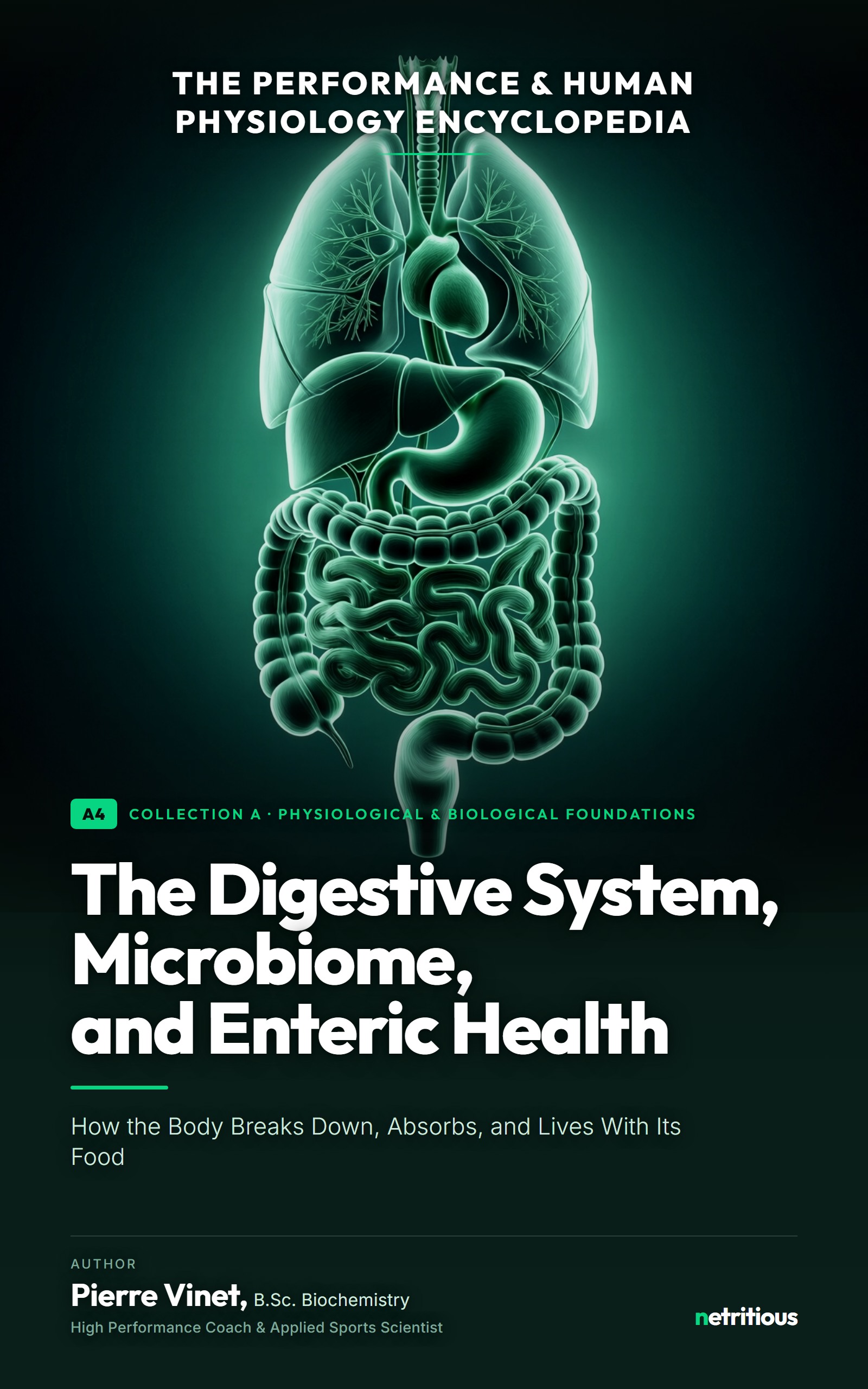
The Digestive System, Microbiome, and Enteric Health
How the Body Breaks Down, Absorbs, and Lives With Its Food
About this volume
The Digestive System, Microbiome, and Enteric Health is Book A4 of The Performance & Human Physiology Encyclopedia — a 93-volume, university-level library on how the human body actually works, system by system. It is written for students, coaches, clinicians and serious self-learners: deep enough that a professional already trained in the field keeps learning, structured clearly enough that a motivated reader can follow every step.
How this book is written
- University level, without dilution. Exact scientific terminology, defined at first use — mechanisms, not just conclusions.
- Myths tested against the evidence. Where a popular claim does not survive the evidence, the book says so — and shows why.
- References at the end of every chapter. Sources cited in APA 7 style, plus a master bibliography.
For general information and education only; not medical advice. Consult a qualified health professional before acting on its content.
Read an excerpt
From Chapter 1 — The Digestive System: Organization and the Logic of Digestion
"Everything you are made of, and everything you burn for energy, once sat on a plate. Between the meal and the molecule lies a tube several meters long and a handful of glands whose job is to take the outside world apart and let just enough of it in."
Book A2 explained how cells make energy; Book A3 explained how the nervous system controls the body. But none of it runs without fuel and raw materials, and those come from food — which is useless until it is broken down into molecules small enough to enter the body. The digestive system is the supply line for everything in this library: the glucose your brain cannot live without (A3, Chapter 1), the amino acids your muscles are built from, the fats, vitamins, and minerals that equip every process. It is also far more than a tube: it houses the microbiome (an organ in its own right), forms the body's largest immune interface, and is in constant two-way conversation with the brain (the gut–brain axis). Understanding its organization explains digestion, bloating, heartburn, and "gut feelings"; it underlies nutrition, appetite, immunity, and even mood; and for athletes it explains why the gut can rebel during hard efforts and how it can be trained. This chapter lays out the map — the processes, the architecture, and the controls — on which the rest of the book is built.
What is inside
The 13 chapters of this volume.
- 01
The Digestive System: Organization and the Logic of Digestion
- 02
The Mouth, Pharynx, and Esophagus: Ingestion and the First Steps
- 03
The Stomach: Reservoir, Acid, and Chemical Attack
- 04
The Small Intestine: The Main Site of Digestion and Absorption
- 05
The Accessory Organs: Pancreas, Liver, and Gallbladder
- 06
Carbohydrate Digestion and Absorption
- 07
Protein Digestion and Absorption
- 08
Lipid Digestion and Absorption
- 09
Water, Electrolytes, Micronutrients, and the Large Intestine
- 10
The Gut Microbiome
- 11
The Gut as a Barrier and Immune Organ
- 12
The Gut–Brain Axis and the Regulation of Appetite
- 13
Digestive Health in Practice: Eating, Performance, and Gut Well-Being
Volume details
Topics covered
- gut health science
- small intestine function
- gut brain axis
- intestinal barrier leaky gut
- digestion and nutrient absorption
- gut bacteria and immunity
- human digestion physiology textbook
Get this volume
This volume is in production. This page will carry the link the day it goes on sale.