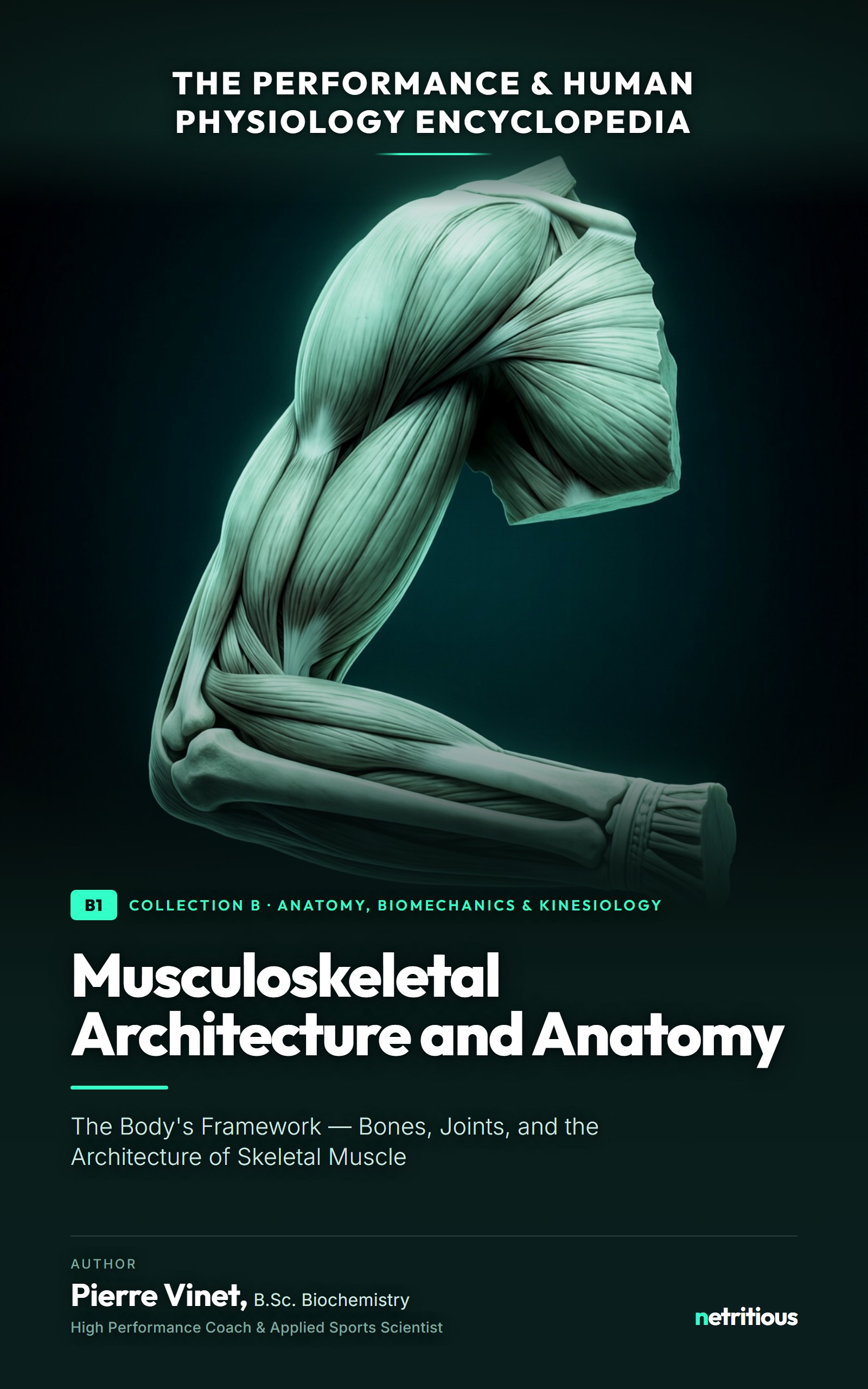
Musculoskeletal Architecture and Anatomy
The Body's Framework — Bones, Joints, and the Architecture of Skeletal Muscle
About this volume
Musculoskeletal Architecture and Anatomy is Book B1 of The Performance & Human Physiology Encyclopedia — a 93-volume, university-level library on how the body produces, transmits and controls movement. It is written for coaches, strength athletes, physiotherapists and kinesiology students: deep enough that a professional already trained in the field keeps learning, structured clearly enough that a motivated reader can follow every step.
How this book is written
- University level, without dilution. Exact scientific terminology, defined at first use — mechanisms, not just conclusions.
- Numbers, formulas, worked examples. Reference ranges, equations and solved calculations you can apply the same day.
- Myths tested against the evidence. Where a popular claim does not survive the evidence, the book says so — and shows why.
- References at the end of every chapter. Sources cited in APA 7 style, plus a master bibliography.
For general information and education only; not medical advice. Consult a qualified health professional before acting on its content.
Read an excerpt
From Chapter 1 — The Language of Anatomy
"Before you can describe how the body moves, you need a language precise enough that two people on opposite sides of the world picture exactly the same thing. 'Lift your arm' is a sentence; 'abduct the glenohumeral joint in the frontal plane about an anteroposterior axis' is an instruction. This chapter builds that language — the agreed reference position, the planes and axes, the directional terms, and the vocabulary of movement — so that everything that follows in this book has a single, unambiguous meaning."
Anatomy is a naming discipline before it is anything else, and the names are not decoration — they are the coordinate system for the rest of Collection B. Every muscle's action ("the biceps brachii flexes the elbow and supinates the forearm"), every joint's classification, every coaching cue, every rehabilitation note, and every research paper assumes this shared frame. Get the language right and a movement description becomes portable and exact; get it loose and "raise your leg to the side" could mean three different joint actions. Whether you train yourself, coach others, treat patients, or simply want to read the rest of this book without friction, this is the chapter that makes all the others legible. It builds on the hierarchy of structure introduced in Book A1 (cells → tissues → organs → systems) and sets up the skeletal, articular, and muscular chapters that follow.
What is inside
The 13 chapters of this volume.
- 01
The Language of Anatomy
- 02
Overview of the Musculoskeletal System
- 03
Bone as a Living Tissue
- 04
The Axial Skeleton
- 05
The Appendicular Skeleton
- 06
Joints: Structure and Classification
- 07
Skeletal Muscle: Gross Architecture
- 08
Skeletal Muscle: Microscopic Architecture & Fiber Types
- 09
How Muscles Produce Movement
- 10
Regional Anatomy I: The Trunk
- 11
Regional Anatomy II: The Upper Limb
- 12
Regional Anatomy III: The Lower Limb
- 13
Musculoskeletal Anatomy in Practice
Volume details
Topics covered
- human skeleton structure guide
- bone remodeling and Wolff's law
- kinesiology for personal trainers
- origins insertions and actions reference
- fiber types sarcomere and pennation
- directional terms planes and axes
- rotator cuff glutes and hamstring actions
Get this volume
This volume is in production. This page will carry the link the day it goes on sale.