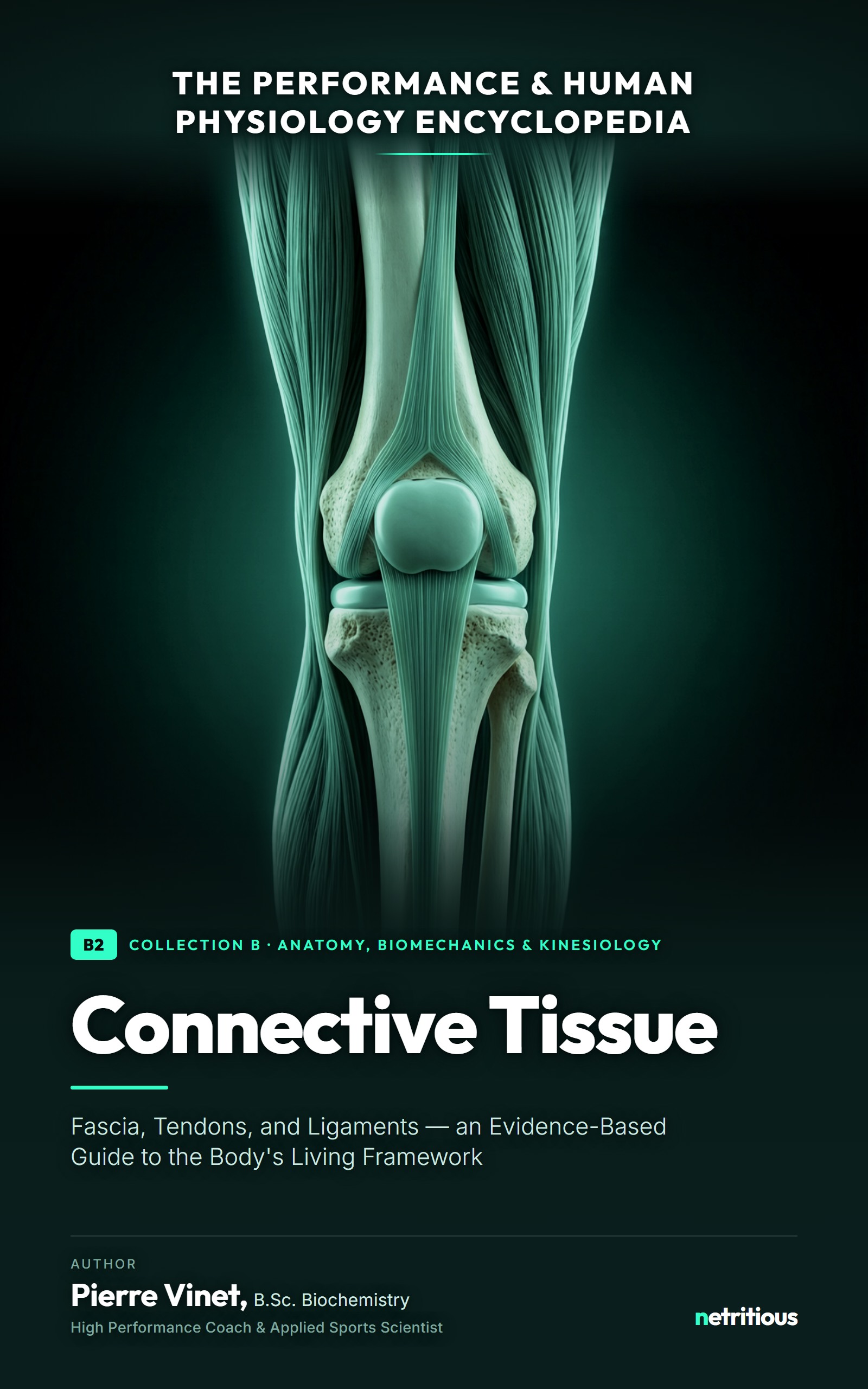
Connective Tissue
Fascia, Tendons, and Ligaments — an Evidence-Based Guide to the Body's Living Framework
About this volume
Connective Tissue is Book B2 of The Performance & Human Physiology Encyclopedia — a 93-volume, university-level library on how the body produces, transmits and controls movement. It is written for coaches, strength athletes, physiotherapists and kinesiology students: deep enough that a professional already trained in the field keeps learning, structured clearly enough that a motivated reader can follow every step.
How this book is written
- University level, without dilution. Exact scientific terminology, defined at first use — mechanisms, not just conclusions.
- Myths tested against the evidence. Where a popular claim does not survive the evidence, the book says so — and shows why.
- References at the end of every chapter. Sources cited in APA 7 style, plus a master bibliography.
For general information and education only; not medical advice. Consult a qualified health professional before acting on its content.
Read an excerpt
From Chapter 1 — Connective Tissue: The Body's Hidden Framework
"Muscles get the glory and bones get the X-rays, but the tissue that actually holds you together — and transmits nearly every force you produce — is the one almost nobody thinks about. Connective tissue is not inert packing. It is a living, sensing, load-responsive network that you can strengthen or weaken, just like muscle and bone. Misunderstand it, and you fall for the two opposite errors: treating it as inert, or treating it as mystical."
Almost every injury that sidelines active people — a strained tendon, a sprained ligament, "tight" fascia, a tendinopathy that won't settle — is a connective-tissue story. So is much of the marketing that surrounds movement: "release," "unwind," "lengthen," collagen powders, fascia gadgets. This chapter gives you the frame to understand the tissue and to see through the hype.
What is inside
The 13 chapters of this volume.
- 01
Connective Tissue: The Body's Hidden Framework
- 02
The Building Blocks: Cells and the Extracellular Matrix
- 03
Collagen: Synthesis, Structure, and Turnover
- 04
Tendons: Structure and Function
- 05
Ligaments: Structure and Function
- 06
Fascia: The Connective Tissue Network
- 07
Cartilage and Other Specialized Connective Tissues
- 08
Mechanobiology: How Connective Tissue Adapts to Load
- 09
Biomechanical Properties: Stress, Strain, and Viscoelasticity
- 10
When Connective Tissue Fails: Injury and Pathology
- 11
Nutrition for Connective Tissue
- 12
Training and Rehabilitating Connective Tissue
- 13
Putting It Into Practice: An Evidence-Based Framework
Volume details
Topics covered
- tendinopathy rehabilitation guide
- collagen synthesis gelatin vitamin C
- foam rolling myofascial release science
- cartilage joint structure anatomy
- stress strain viscoelasticity biomechanics
- athlete injury prevention load adaptation
- sports anatomy physiology textbook
Get this volume
This volume is in production. This page will carry the link the day it goes on sale.