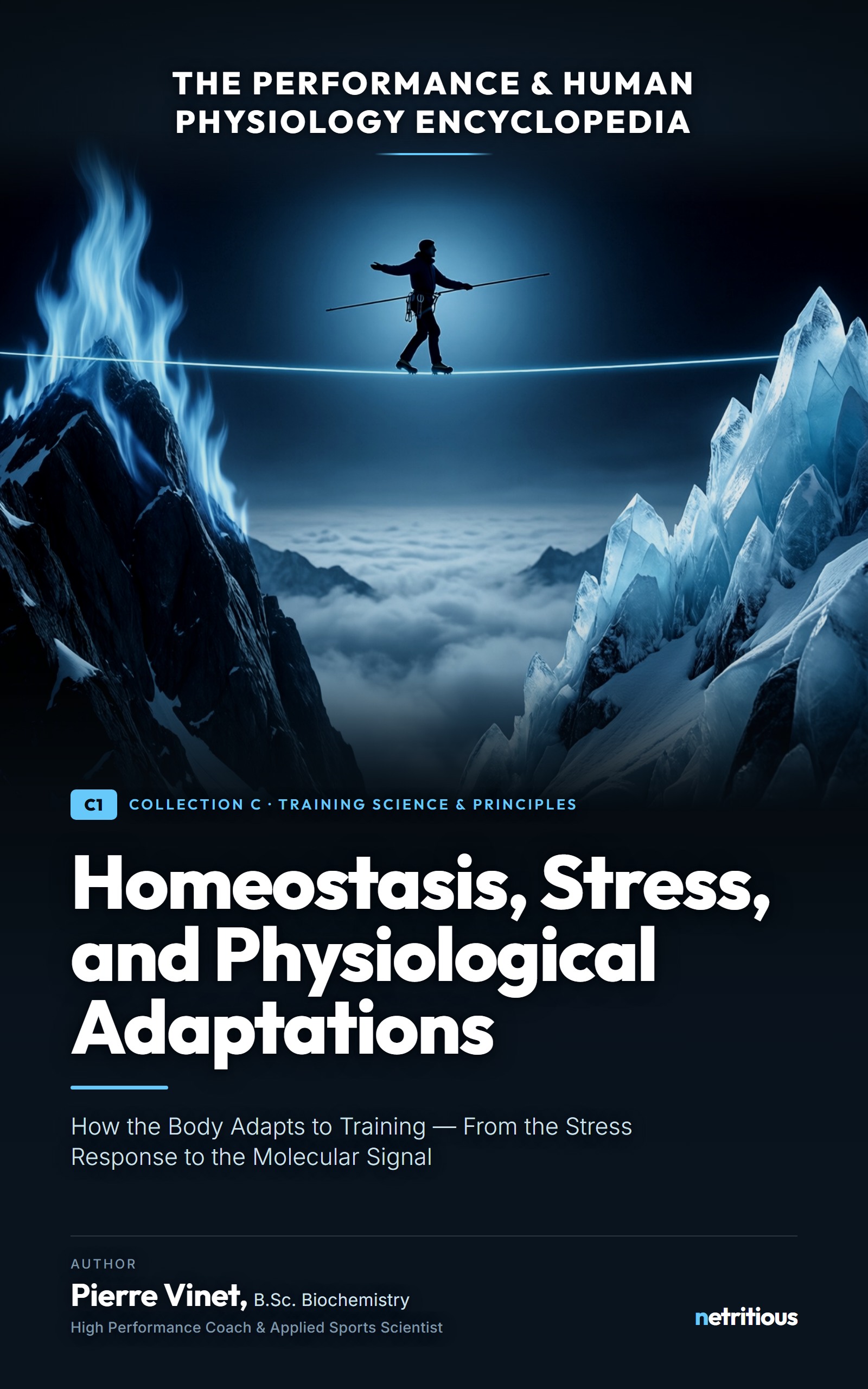
Homeostasis, Stress, and Physiological Adaptations
How the Body Adapts to Training — From the Stress Response to the Molecular Signal
About this volume
Homeostasis, Stress, and Physiological Adaptations is Book C1 of The Performance & Human Physiology Encyclopedia — a 93-volume, university-level library on the science that decides whether training works. It is written for coaches, personal trainers and athletes who want reasons, not recipes: deep enough that a professional already trained in the field keeps learning, structured clearly enough that a motivated reader can follow every step.
How this book is written
- University level, without dilution. Exact scientific terminology, defined at first use — mechanisms, not just conclusions.
- Myths tested against the evidence. Where a popular claim does not survive the evidence, the book says so — and shows why.
- References at the end of every chapter. Sources cited in APA 7 style, plus a master bibliography.
For general information and education only; not medical advice. Consult a qualified health professional before acting on its content.
Read an excerpt
From Chapter 1 — The Logic of Adaptation
"Training does not build the body directly. A workout does not add muscle or fitness — it sends a signal. The body, threatened by an unfamiliar demand, rebuilds itself to be better prepared next time. Every effective training program, from a beginner's first push-ups to an Olympian's periodized year, is an attempt to send that signal deliberately, recover from it, and send it again — slightly harder. This book is about the signal and the response: the science of how the body adapts."
Every decision in training — how heavy, how often, how much, how to recover — is ultimately a bet about adaptation: what signal will the body interpret, and how will it respond? Without understanding adaptation, training is guesswork and slogans; with it, training becomes a rational, testable practice. This book provides that foundation, and it opens Collection C (Training Science): the principles here underlie how we choose loading parameters (C3), how we execute exercises (C4), and how we design programs (the D collection). It connects the physiology of Collection A and the mechanics of Collection B to the practical question of how to get better.
What is inside
The 13 chapters of this volume.
- 01
The Logic of Adaptation
- 02
Homeostasis, Allostasis, and the Stress Response
- 03
Selye's General Adaptation Syndrome
- 04
Supercompensation and the Fitness–Fatigue Model
- 05
The SAID Principle and Specificity of Adaptation
- 06
Molecular Signaling I: Mechanotransduction & the mTOR Pathway
- 07
Molecular Signaling II: Energy Stress, AMPK & Concurrent Training
- 08
Muscle Damage, the Repeated Bout Effect & DOMS
- 09
Acute Responses vs. Chronic Adaptations
- 10
Fatigue, Recovery, and Frequency
- 11
Overload, Overreaching, and Overtraining
- 12
Individuality, Reversibility & the Adaptation Ceiling
- 13
Applied Adaptation: Programming to Drive Adaptation
Volume details
Topics covered
- supercompensation and fitness fatigue model
- overreaching and overtraining syndrome
- mtor ampk muscle growth pathways
- repeated bout effect and muscle soreness
- SAID principle specificity of exercise
- general adaptation syndrome exercise science
- recovery frequency and progressive overload
Get this volume
This volume is in production. This page will carry the link the day it goes on sale.