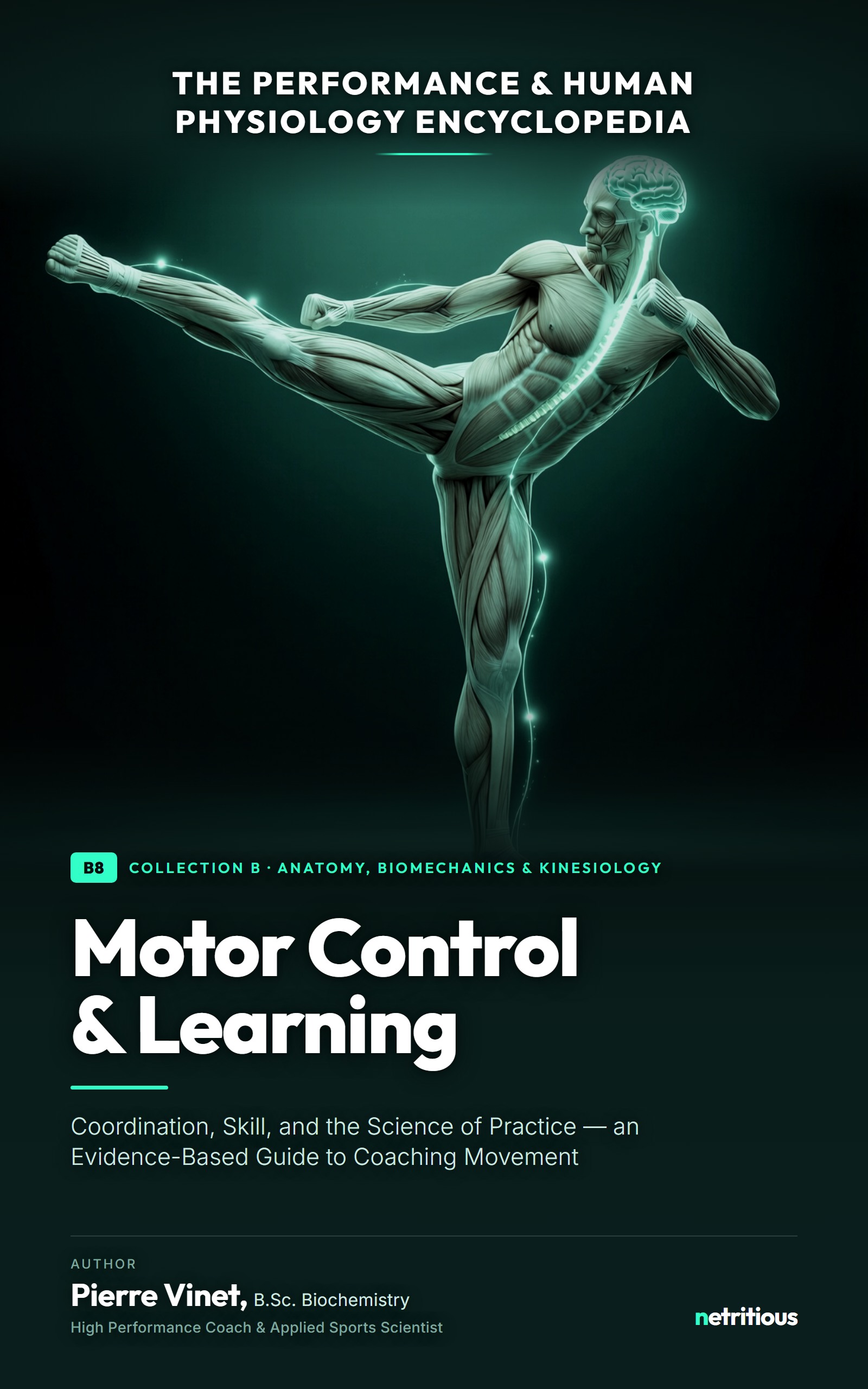
Motor Control & Learning
Coordination, Skill, and the Science of Practice — an Evidence-Based Guide to Coaching Movement
About this volume
Motor Control & Learning is Book B8 of The Performance & Human Physiology Encyclopedia — a 93-volume, university-level library on how the body produces, transmits and controls movement. It is written for coaches, strength athletes, physiotherapists and kinesiology students: deep enough that a professional already trained in the field keeps learning, structured clearly enough that a motivated reader can follow every step.
How this book is written
- University level, without dilution. Exact scientific terminology, defined at first use — mechanisms, not just conclusions.
- Myths tested against the evidence. Where a popular claim does not survive the evidence, the book says so — and shows why.
- References at the end of every chapter. Sources cited in APA 7 style, plus a master bibliography.
For general information and education only; not medical advice. Consult a qualified health professional before acting on its content.
Read an excerpt
From Chapter 1 — Movement as a Skill: The Logic of Motor Control
"We train muscles as if they were the point. But a muscle is only an actuator — it does what the nervous system tells it. Coordination, technique, balance, the difference between a novice and an expert: these live in the brain and spinal cord, not the biceps. Treat movement as a skill the nervous system learns, and you stop chasing gadgets and start using the actual levers."
Coaches, clinicians, and athletes spend enormous effort on how to move and how to get better at moving. This book gives the science behind both — turning vague notions ("muscle memory," "core stability," "drill it till it's automatic") into principles you can apply.
What is inside
The 13 chapters of this volume.
- 01
Movement as a Skill: The Logic of Motor Control
- 02
The Neural Hierarchy of Movement
- 03
The Motor Unit and Muscle Recruitment
- 04
Sensory Feedback and Proprioception
- 05
Theories of Motor Control
- 06
Coordination and the Degrees of Freedom Problem
- 07
Motor Learning: Stages and Mechanisms
- 08
Practice Design for Learning
- 09
Feedback and Augmented Information
- 10
Attention, Focus, and Performing Under Pressure
- 11
Transfer, Retention, and Specificity
- 12
Balance, Posture, and the "Core"
- 13
Putting It Into Practice: Coaching Movement and Skill
Volume details
Topics covered
- motor learning and skill acquisition
- practice design for coaches
- external focus of attention cueing
- degrees of freedom problem
- feedback and skill retention
- balance posture and core control
- choking under pressure skill
Get this volume
This volume is in production. This page will carry the link the day it goes on sale.