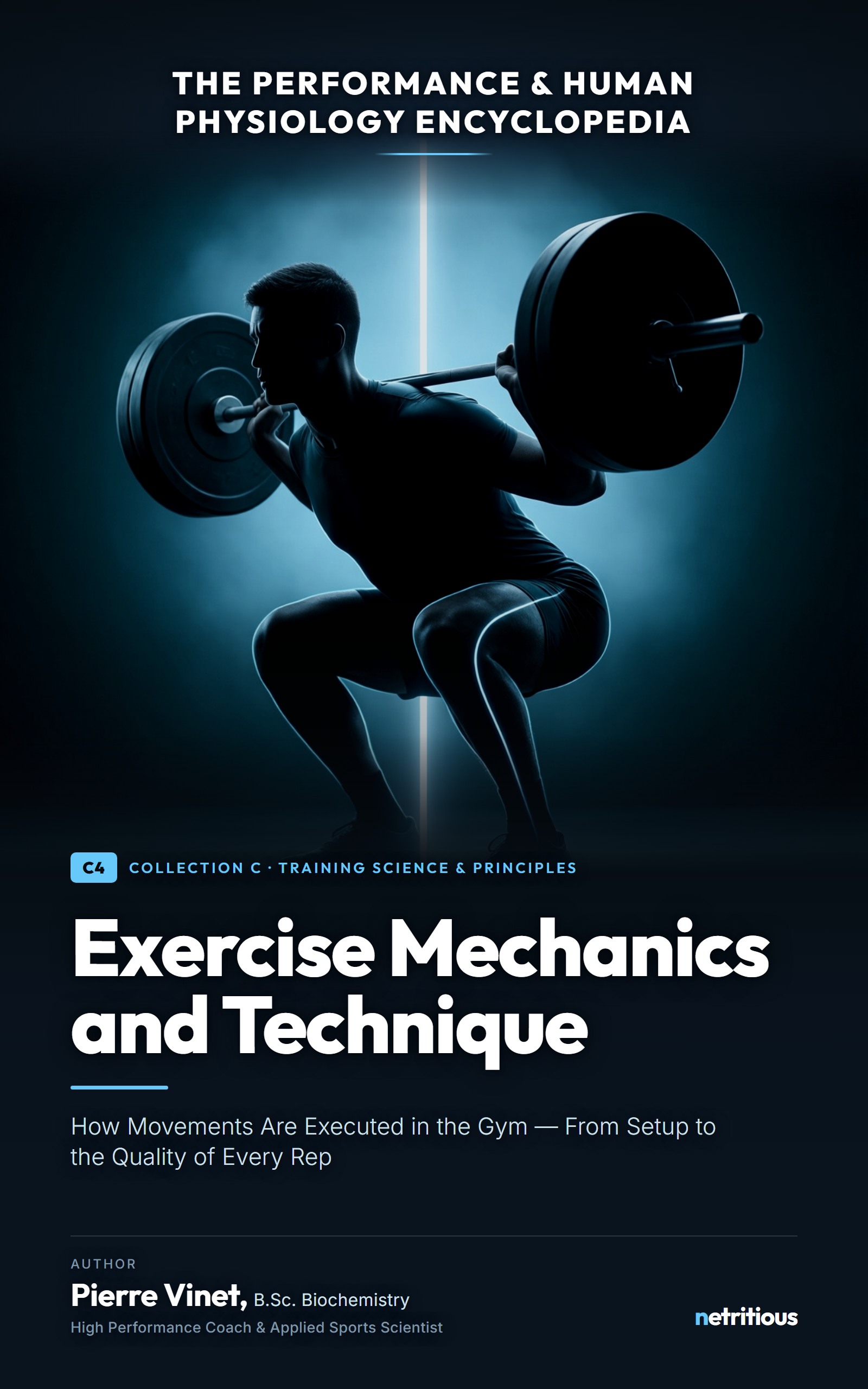
Exercise Mechanics and Technique
How Movements Are Executed in the Gym — From Setup to the Quality of Every Rep
About this volume
Exercise Mechanics and Technique is Book C4 of The Performance & Human Physiology Encyclopedia — a 93-volume, university-level library on the science that decides whether training works. It is written for coaches, personal trainers and athletes who want reasons, not recipes: deep enough that a professional already trained in the field keeps learning, structured clearly enough that a motivated reader can follow every step.
How this book is written
- University level, without dilution. Exact scientific terminology, defined at first use — mechanisms, not just conclusions.
- Myths tested against the evidence. Where a popular claim does not survive the evidence, the book says so — and shows why.
- References at the end of every chapter. Sources cited in APA 7 style, plus a master bibliography.
For general information and education only; not medical advice. Consult a qualified health professional before acting on its content.
Read an excerpt
From Chapter 1 — Technique as the Delivery of the Stimulus
"Book C3 told you the training dose — how much, how hard, how often. But a dose written on paper does nothing until a body executes it. Technique is how the prescribed stimulus is actually delivered to the tissue you intend to train. The same set of squats can load the quadriceps, the hips, or the lower back to very different degrees depending on how it is performed. Execution is not a cosmetic detail layered on top of programming — it is the mechanism by which programming reaches the muscle. This book is about getting that delivery right."
A perfectly designed program (C3) delivered through poor execution under- or mis-loads the target tissue, wastes effort, and raises injury risk; a sound program delivered well does exactly what it was designed to do. Technique is therefore not separate from results — it is how results happen. Understanding execution as the delivery of the stimulus, rather than as arbitrary rules to obey, lets you reason about any exercise, adapt it to the individual, and avoid both sloppy lifting and rigid "perfect-form" dogma. This framing governs the entire book and connects the dose (C3) to real adaptation in the body.
What is inside
The 13 chapters of this volume.
- 01
Technique as the Delivery of the Stimulus
- 02
The Universals of Good Technique
- 03
Setup, Bracing, and Intra-Abdominal Pressure
- 04
The Squat Pattern
- 05
The Hinge and the Pull
- 06
Upper-Body Pressing
- 07
Upper-Body Pulling
- 08
Isolation, Arms, and Tempo
- 09
The Olympic Lifts and Power Derivatives
- 10
Machines, Free Weights, Cables, and Bodyweight
- 11
Coaching, Cueing, and Correcting Technique
- 12
Assessing Movement and Muscle Function: Evidence vs. Claims Without Evidence
- 13
Applied Execution: A Technique Workflow
Volume details
Topics covered
- squat and deadlift form guide
- lifting form for beginners
- olympic lifting snatch clean and jerk
- bench press form explained
- barbell lifts coaching cues
- strength training form and safety
- bracing and breathing when lifting
Get this volume
This volume is in production. This page will carry the link the day it goes on sale.