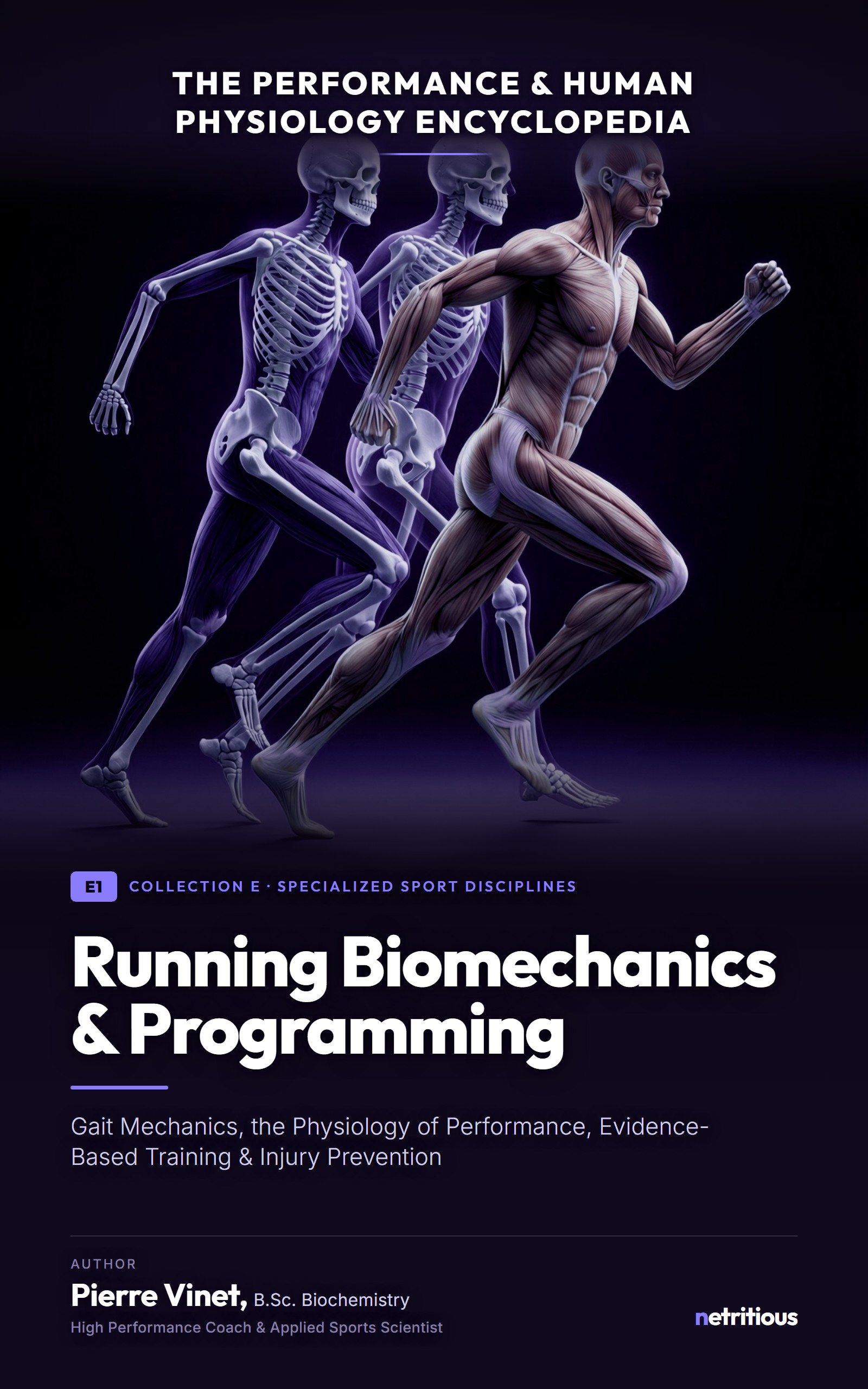
Running Biomechanics & Programming
Gait Mechanics, the Physiology of Performance, Evidence-Based Training & Injury Prevention
About this volume
Running Biomechanics & Programming is Book E1 of The Performance & Human Physiology Encyclopedia — a 93-volume, university-level library on the physiology, technique and programming of a specific sport. It is written for competitive athletes and the coaches who prepare them: deep enough that a professional already trained in the field keeps learning, structured clearly enough that a motivated reader can follow every step.
How this book is written
- University level, without dilution. Exact scientific terminology, defined at first use — mechanisms, not just conclusions.
- Evidence graded, not asserted. Major claims carry a level, from A (strong) to D (expert opinion), so you always know how much weight to give them.
- Numbers, formulas, worked examples. Reference ranges, equations and solved calculations you can apply the same day.
- Myths tested against the evidence. Where a popular claim does not survive the evidence, the book says so — and shows why.
- References at the end of every chapter. Sources cited in APA 7 style, plus a master bibliography.
For general information and education only; not medical advice. Consult a qualified health professional before acting on its content.
Read an excerpt
From Chapter 1 — The Science of Running: An Introduction
"Running looks like the simplest sport: no equipment, no field, no opponent — just a body and the ground. Yet beneath that simplicity sits some of the richest applied science in all of human movement. Every stride is a controlled collision in which your body absorbs two to three times its own weight, stores and returns elastic energy like a spring, and converts chemical fuel into forward motion with an efficiency that is itself trainable. Run well and the rewards are extraordinary — cardiovascular health, longevity, performance, and for many people, sanity. Run carelessly and roughly half of all runners are injured within a year. This book is about closing that gap: understanding how running works mechanically, what makes one runner faster than another physiologically, how to program training that actually improves you, and how to stay healthy doing it. And it is about doing all of this honestly — because few activities are surrounded by as many confident, unproven claims as running."
Running is the most-practiced sport on Earth and one of the most cost-effective health interventions ever studied — yet it carries one of the highest injury rates of any recreational activity, and it is saturated with persistent myths. Whether you run for your own health and performance, coach others, or advise athletes professionally, you need a model that separates what the mechanics and physiology actually say from what marketing and folklore claim. This chapter builds that frame: why we run, what limits running performance, why injuries happen, and the honest, evidence-based posture the rest of the book takes.
What is inside
The 13 chapters of this volume.
- 01
The Science of Running: An Introduction
- 02
The Running Gait Cycle
- 03
Kinetics & Kinematics of Running
- 04
Footstrike, Cadence & Running Form
- 05
Running Footwear: Cushioning, Minimalism & Super Shoes
- 06
The Physiology of Running Performance
- 07
Running Economy
- 08
Training Principles & Methods for Runners
- 09
Designing a Training Program: Periodization for Distance Running
- 10
Strength Training & Conditioning for Runners
- 11
Running Injuries: Epidemiology, Mechanisms & Prevention
- 12
Terrain, Environment, Fueling & Special Populations
- 13
Putting It All Together: Applied Running Science
Volume details
Topics covered
- marathon half marathon 10K plans
- cadence footstrike overstriding
- carbon plate super shoes economy
- periodization tapering long run
- shin splints runner's knee overuse
- lactate threshold VO2max pacing
- beginner 5K masters runners
Get this volume
This volume is in production. This page will carry the link the day it goes on sale.