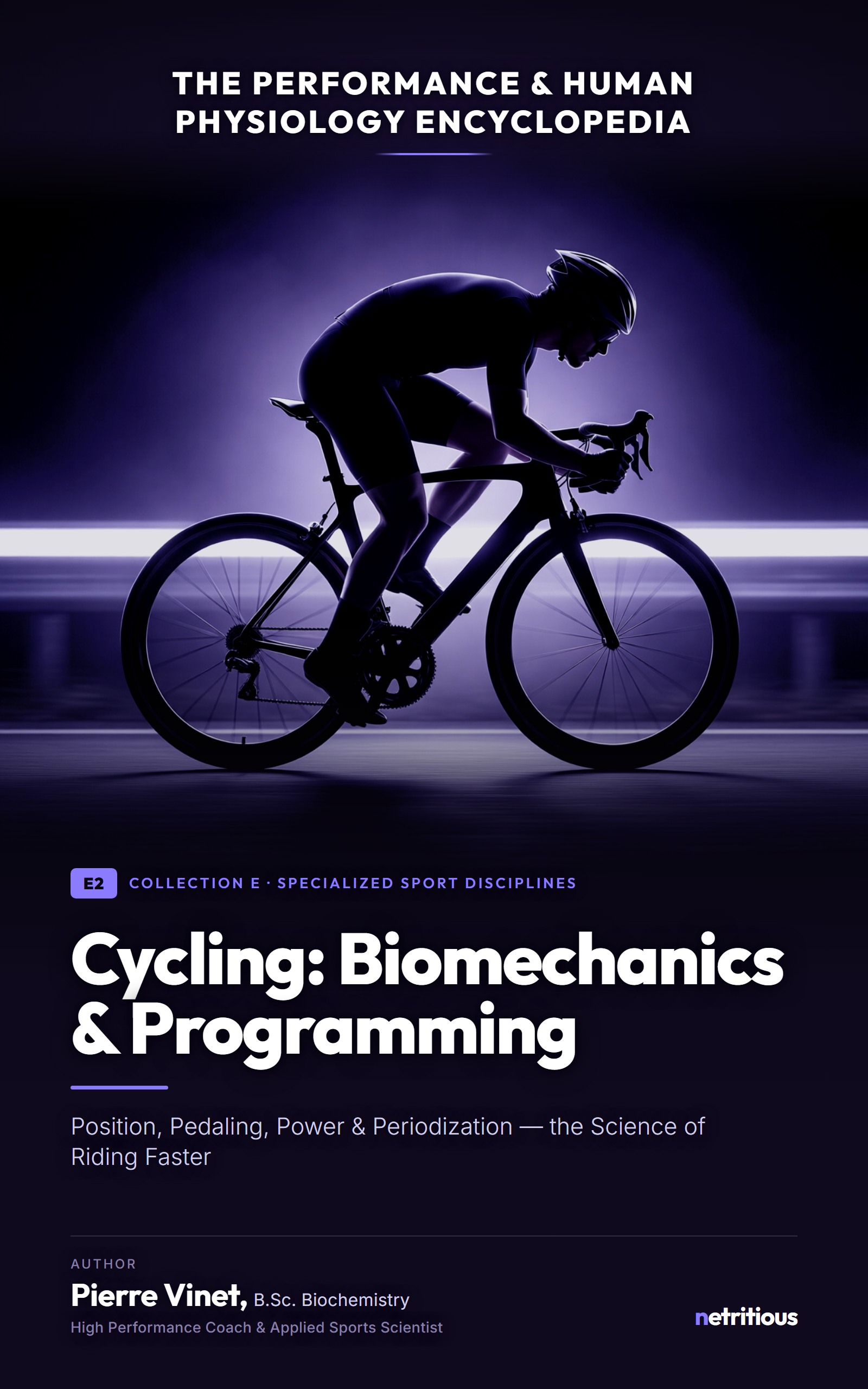
Cycling: Biomechanics & Programming
Position, Pedaling, Power & Periodization — the Science of Riding Faster
About this volume
Cycling: Biomechanics & Programming is Book E2 of The Performance & Human Physiology Encyclopedia — a 93-volume, university-level library on the physiology, technique and programming of a specific sport. It is written for competitive athletes and the coaches who prepare them: deep enough that a professional already trained in the field keeps learning, structured clearly enough that a motivated reader can follow every step.
How this book is written
- University level, without dilution. Exact scientific terminology, defined at first use — mechanisms, not just conclusions.
- Numbers, formulas, worked examples. Reference ranges, equations and solved calculations you can apply the same day.
- Myths tested against the evidence. Where a popular claim does not survive the evidence, the book says so — and shows why.
- References at the end of every chapter. Sources cited in APA 7 style, plus a master bibliography.
For general information and education only; not medical advice. Consult a qualified health professional before acting on its content.
Read an excerpt
From Chapter 1 — What Makes a Cyclist Fast
"Cycling speed comes down to a single tension: the power you can produce versus the forces trying to slow you down. On the flat, the enemy is air; on a climb, it's gravity. Everything else in this book — training, position, pedaling, pacing — is about putting more power into that equation, or taking drag and weight out of it. Get the model right and the whole sport organizes itself."
Cyclists drown in advice — about gear, position, intervals, and gadgets — without a framework to judge any of it. The power-versus-resistance model is that framework. It tells you what actually makes you faster, what's a rounding error, and where marketing oversells. Every later chapter plugs into it.
What is inside
The 13 chapters of this volume.
- 01
What Makes a Cyclist Fast
- 02
The Physics of Cycling
- 03
Cycling Physiology & the Power-Duration Curve
- 04
Bike Fit & Rider Position
- 05
Pedaling Mechanics
- 06
Measuring Intensity: Power, HR & RPE
- 07
Building the Aerobic Engine
- 08
Developing Threshold, VO2max & Anaerobic Power
- 09
Strength & Off-the-Bike Training
- 10
Periodization & Planning
- 11
Climbing, Sprinting & Race Skills
- 12
Nutrition, Recovery & Common Issues
- 13
Putting It Into Practice
Volume details
Topics covered
- road bike power training FTP
- bike fit and rider position
- bike aerodynamics and watts
- structured interval training plan cyclist
- cyclist strength training
- periodization for cyclists
- climbing and sprinting race skills
Get this volume
This volume is in production. This page will carry the link the day it goes on sale.