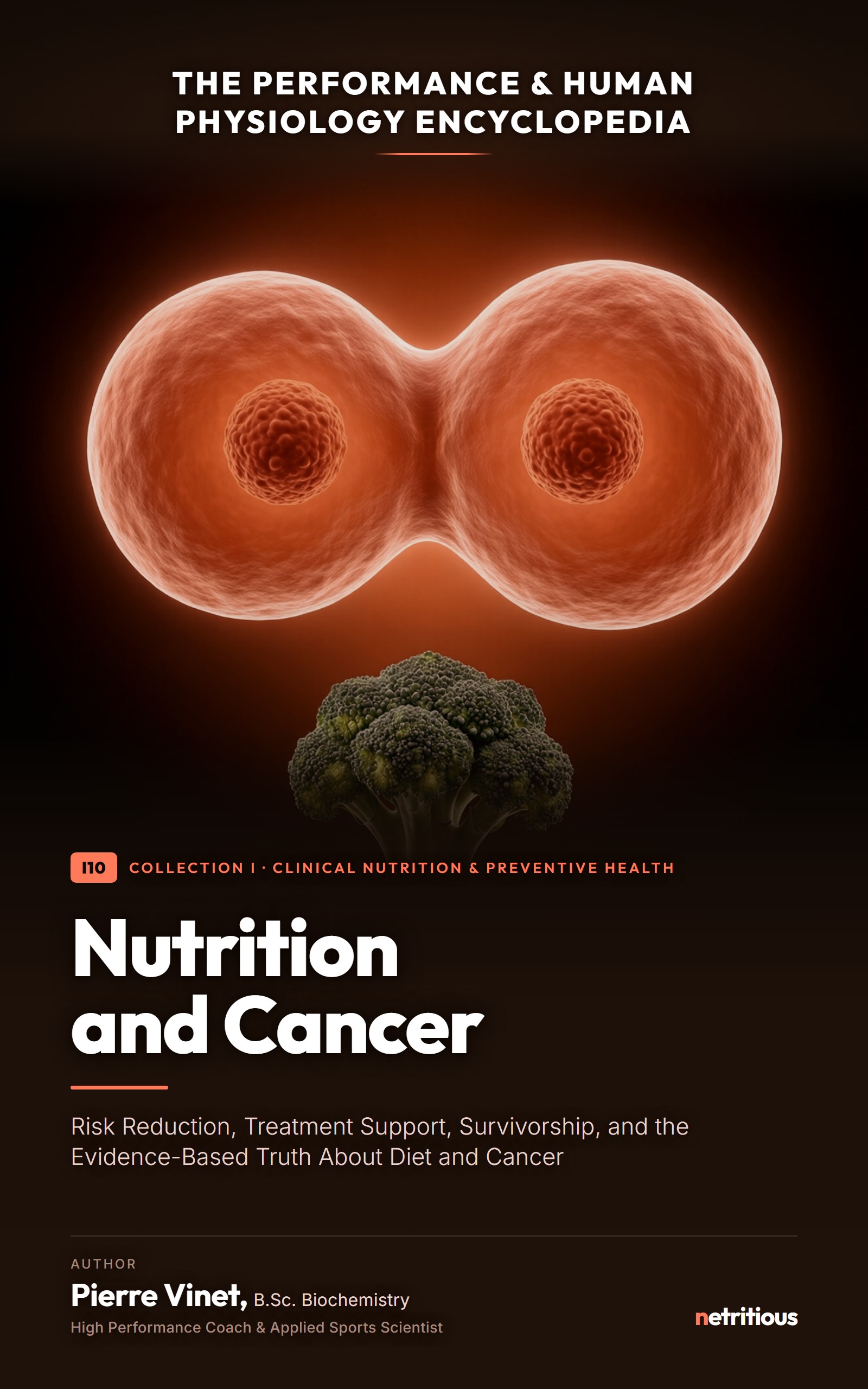
Nutrition and Cancer
Risk Reduction, Treatment Support, Survivorship, and the Evidence-Based Truth About Diet and Cancer
About this volume
Nutrition and Cancer is Book I10 of The Performance & Human Physiology Encyclopedia — a 93-volume, university-level library on food as medicine, applied honestly to a specific condition. It is written for dietitians, health professionals, patients and preventive-minded readers: deep enough that a professional already trained in the field keeps learning, structured clearly enough that a motivated reader can follow every step.
How this book is written
- University level, without dilution. Exact scientific terminology, defined at first use — mechanisms, not just conclusions.
- Myths tested against the evidence. Where a popular claim does not survive the evidence, the book says so — and shows why.
- References at the end of every chapter. Sources cited in APA 7 style, plus a master bibliography.
For general information and education only; not medical advice. Consult a qualified health professional before acting on its content.
Read an excerpt
From Chapter 1 — Cancer, Diet, and Why Nutrition Matters
"Few words frighten like 'cancer,' and few questions follow a diagnosis faster than 'What should I eat?' The honest answer is neither of the two stories the internet tells. Food did not single-handedly give you cancer, and no food will cure it. But across a lifetime, what we eat, drink, weigh, and how we move genuinely shapes the risk of ever getting many cancers — and once cancer is being treated, good nutrition is one of the quiet things that helps a body endure it. This book is about that honest, hopeful middle."
Cancer is among the most common and most feared diagnoses in human health. Worldwide, it is a leading cause of death — roughly one in five people will develop cancer in their lifetime, and it accounts for close to 10 million deaths a year (Sung et al., 2021). Almost everyone has either faced cancer or loved someone who has. Understandably, a diagnosis — or simply the wish to avoid one — sends people searching for answers, and the loudest answers are often about food: anti-cancer "superfoods," sugar that supposedly "feeds" tumors, alkaline diets, juice cleanses, and a thousand supplements promising protection or cure.
This book is an honest, evidence-based guide to the relationship between nutrition and cancer — what diet genuinely does for cancer risk, what it does (and doesn't do) during treatment, what helps in survivorship, and how to navigate a field crowded with both fear and false hope. It is written for everyone: whether you want to lower your risk, you have a diagnosis, you support someone who does, you coach or teach, or you work in a health field and want a rigorous, myth-busting account.
A grounding truth shapes everything that follows:
Diet meaningfully affects the risk of developing many cancers, and good nutrition genuinely supports people through treatment and survivorship — but no food, diet, or supplement cures or "starves" cancer. Nutrition is a powerful lever for prevention at the population level, and a valuable complement to medical care once cancer is present — never a substitute for it (this is Book N4 in the library's scope-of-practice framework). This is not a "beat cancer with food" book, and it is not a "diet is irrelevant" book. It is an honest map of where nutrition truly matters.
What is inside
The 13 chapters of this volume.
- 01
Cancer, Diet, and Why Nutrition Matters
- 02
What Cancer Is: A Biology Primer
- 03
How Diet Affects Cancer Risk: The Mechanisms
- 04
The Big Levers of Prevention: Weight, Activity, and Alcohol
- 05
Foods and Dietary Patterns for Prevention
- 06
Myths and Misconceptions: Sugar, Alkaline, Detox, and "Superfoods"
- 07
Supplements and Cancer: Hope, Hype, and Harm
- 08
Nutrition During Cancer Treatment
- 09
Cancer Cachexia: The Metabolic Wasting Syndrome
- 10
The Fasting and Ketogenic Diet Questions
- 11
Survivorship: Eating After Cancer
- 12
Special Situations and Specific Cancers
- 13
Putting It All Together: An Evidence-Based Approach
Volume details
Topics covered
- eating well during chemotherapy
- cachexia and unintentional weight loss
- does sugar feed tumors
- alcohol and obesity link to tumors
- ketogenic eating and fasting oncology
- antioxidant supplements and chemotherapy
- oncology dietitian guide for patients
Get this volume
This volume is in production. This page will carry the link the day it goes on sale.