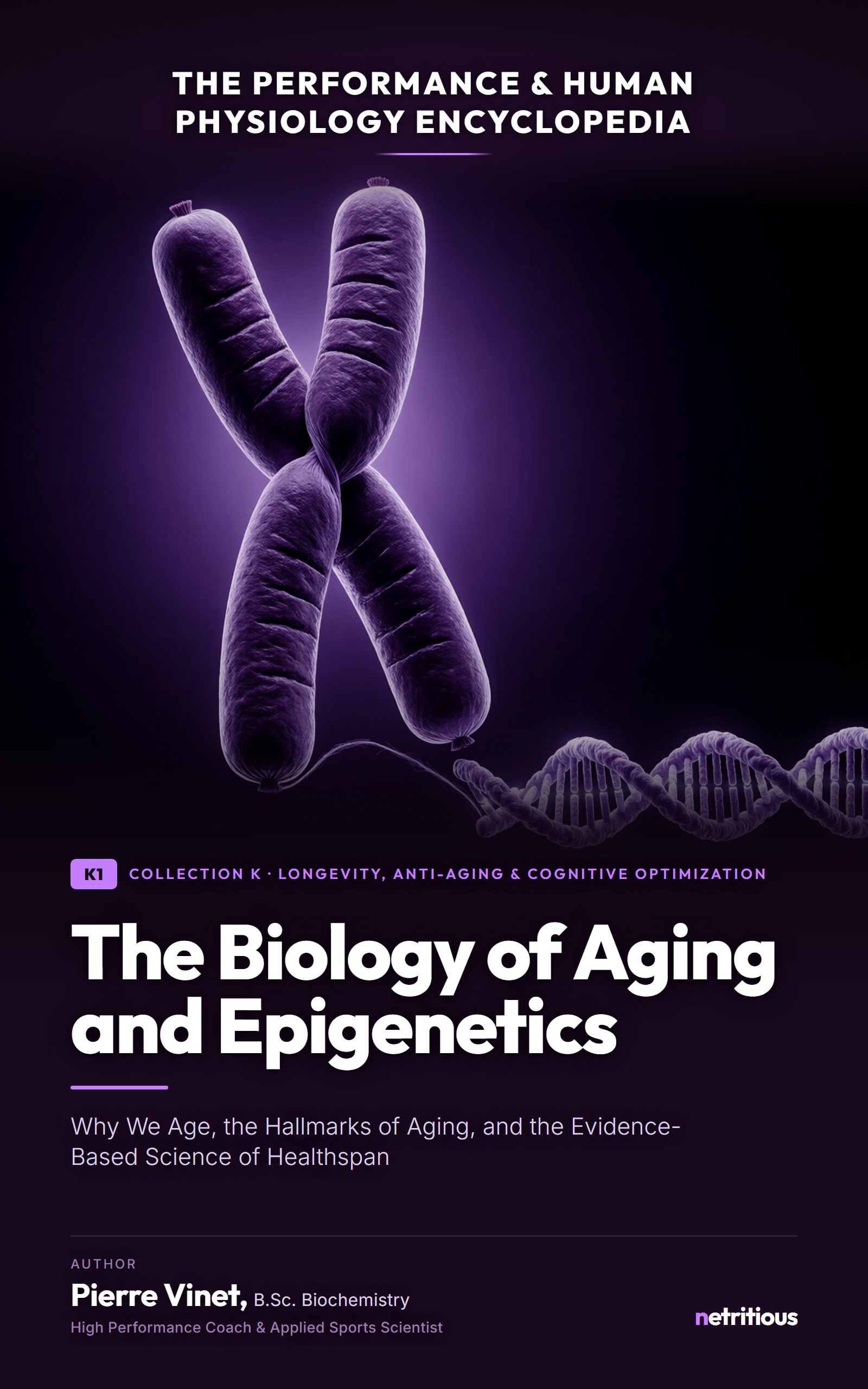
The Biology of Aging and Epigenetics
Why We Age, the Hallmarks of Aging, and the Evidence-Based Science of Healthspan
About this volume
The Biology of Aging and Epigenetics is Book K1 of The Performance & Human Physiology Encyclopedia — a 93-volume, university-level library on what genuinely extends healthspan, and what is being sold to you. It is written for longevity-minded readers, biohackers and clinicians who want the evidence: deep enough that a professional already trained in the field keeps learning, structured clearly enough that a motivated reader can follow every step.
How this book is written
- University level, without dilution. Exact scientific terminology, defined at first use — mechanisms, not just conclusions.
- Myths tested against the evidence. Where a popular claim does not survive the evidence, the book says so — and shows why.
- References at the end of every chapter. Sources cited in APA 7 style, plus a master bibliography.
For general information and education only; not medical advice. Consult a qualified health professional before acting on its content.
Read an excerpt
From Chapter 1 — What Is Aging? Concepts, Definitions, and Why It Matters
"Everyone ages, almost no one understands how. We treat aging as a single, inevitable slide — 'wear and tear' — when biology now tells a richer and more hopeful story: aging is a set of interconnected, partly modifiable processes. This book is about that science. It will not promise you immortality or sell you a supplement. It will give you an honest map of why we age, what the evidence supports, and how to think clearly in a field drowning in hype."
Aging is the largest single risk factor for most of the diseases that end human lives — cardiovascular disease, most cancers, type 2 diabetes, neurodegeneration. Yet for most of history it was treated as a brute fact, beyond explanation or influence. In the last two decades, the biology of aging (the field of biogerontology, and the broader geroscience that links aging to disease) has matured into a rigorous science with a shared framework — the hallmarks of aging — and a growing, if still early, set of interventions.
This book is a rigorous, honest, evidence-based guide to why we age — the biology, the hallmarks, the role of epigenetics, and the real science of extending not just lifespan but healthspan. It is written for everyone: whether you're personally curious about living well for longer, you coach or teach, you work in a health field, or you simply want to separate the genuine science from the enormous "anti-aging" hype industry.
A grounding truth shapes everything that follows:
Aging is not a single thing or simple "wear and tear" — it is a set of interconnected biological processes (the hallmarks of aging), partly heritable and partly modifiable. The realistic, evidence-based goal is to extend healthspan (years lived in good health), not to achieve immortality. A handful of unglamorous levers (not smoking, exercise, sleep, diet, social connection) have strong evidence; most "anti-aging" supplements, clinics, and "reprogramming" cures do not — they are unproven in humans. This book explains the biology and respects the boundary between science and salesmanship; it is informational, not a medical anti-aging protocol (Book N4).
What is inside
The 13 chapters of this volume.
- 01
What Is Aging? Concepts, Definitions, and Why It Matters
- 02
Theories of Aging
- 03
The Hallmarks of Aging: An Overview
- 04
Genomic Instability and DNA Damage
- 05
Telomere Attrition
- 06
Epigenetic Alterations and the Epigenetic Clock
- 07
Loss of Proteostasis and the Role of Autophagy
- 08
Deregulated Nutrient Sensing
- 09
Mitochondrial Dysfunction
- 10
Cellular Senescence and the SASP
- 11
Stem Cell Exhaustion and the Aging Body
- 12
Measuring and Modifying Aging: Biomarkers, Interventions, and the Hype
- 13
Putting It All Together: An Evidence-Based Approach to Healthy Aging
Volume details
Topics covered
- telomere shortening explained
- DNA methylation clocks explained
- senescent cells and inflammation
- autophagy and protein quality control
- nutrient sensing pathways and insulin signaling
- biological vs chronological age
- geroscience textbook for beginners
Get this volume
This volume is in production. This page will carry the link the day it goes on sale.