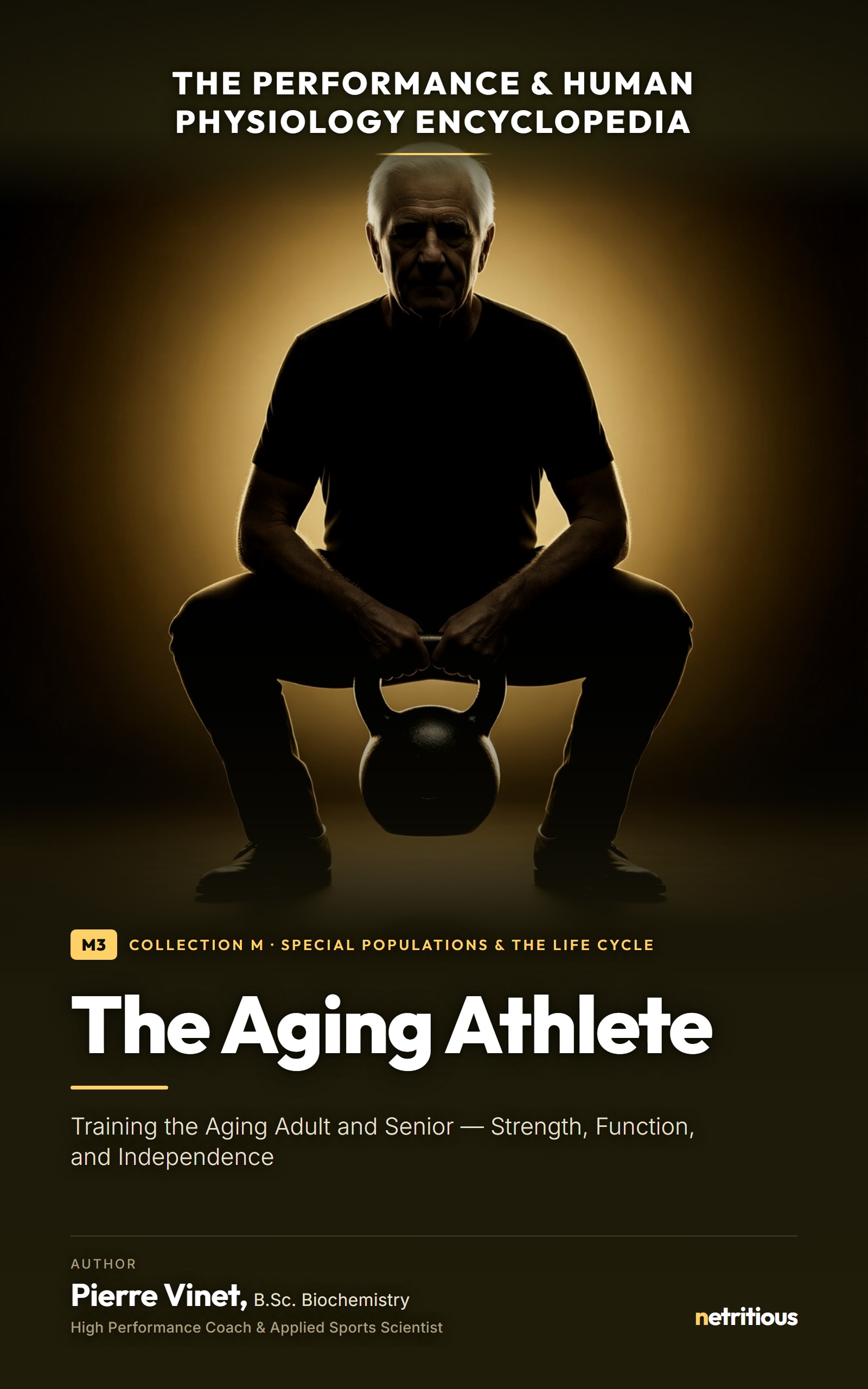
The Aging Athlete
Training the Aging Adult and Senior — Strength, Function, and Independence
About this volume
The Aging Athlete is Book M3 of The Performance & Human Physiology Encyclopedia — a 93-volume, university-level library on how training and nutrition must change for a specific population. It is written for coaches and clinicians serving women, youth, older adults and clinical populations: deep enough that a professional already trained in the field keeps learning, structured clearly enough that a motivated reader can follow every step.
How this book is written
- University level, without dilution. Exact scientific terminology, defined at first use — mechanisms, not just conclusions.
- Evidence graded, not asserted. Major claims carry a level, from A (strong) to D (expert opinion), so you always know how much weight to give them.
- Myths tested against the evidence. Where a popular claim does not survive the evidence, the book says so — and shows why.
- References at the end of every chapter. Sources cited in APA 7 style, plus a master bibliography.
For general information and education only; not medical advice. Consult a qualified health professional before acting on its content.
Read an excerpt
From Chapter 1 — Training the Aging Adult: Why It's Never Too Late
"Much of what we call 'aging' is associated with disuse — the slow surrender of strength, power, and capacity that comes not from the calendar but from doing less. One of the most important and best-supported things an older adult can do is not a pill, a supplement, or a clinic; it is exercise, and above all, building and keeping strength. And the most encouraging fact in this whole field is that it is never too late to start: even people in their nineties have been shown to get stronger when they train."
Aging is universal, but the rate and experience of physical aging vary enormously — and far more of that variation is modifiable than most people believe. Too often, declining strength, balance, energy, and independence are accepted as the inevitable price of getting older, and exercise (especially strength training) is seen as inappropriate, risky, or pointless for older adults. Both assumptions are wrong — and costly.
This book is for everyone who is aging (which is everyone) — older adults and seniors themselves, the caregivers and family who support them, and the coaches, trainers, and clinicians who work with them. As with every book in this series, it is inclusive and written at a university level while remaining friendly. Its companion in this library is Collection K (the biology of aging and longevity); where K explains why we age and the broad longevity picture, M3 is the applied "training" book: how to train the aging body to preserve strength, function, and independence.
What is inside
The 13 chapters of this volume.
- 01
Training the Aging Adult: Why It's Never Too Late
- 02
The Biology of Aging for the Exerciser
- 03
Sarcopenia and Dynapenia: Muscle, Strength, and Power Loss
- 04
Resistance Training: The Master Intervention
- 05
Power Training: The Underrated Priority
- 06
Bone Health and Osteoporosis
- 07
Balance, Mobility, and Falls Prevention
- 08
Cardiorespiratory Fitness in the Aging Adult
- 09
Functional Capacity and Independence
- 10
Nutrition for the Aging Adult
- 11
Training with Age-Related Conditions
- 12
Programming for the Older Adult
- 13
Building Lifelong Strength and Independence: An Evidence-Based Framework
Volume details
Topics covered
- sarcopenia muscle loss
- exercise over 60
- falls prevention balance
- osteoporosis and exercise
- power training over 50
- masters athletes training
- retirement fitness plan
Get this volume
This volume is in production. This page will carry the link the day it goes on sale.