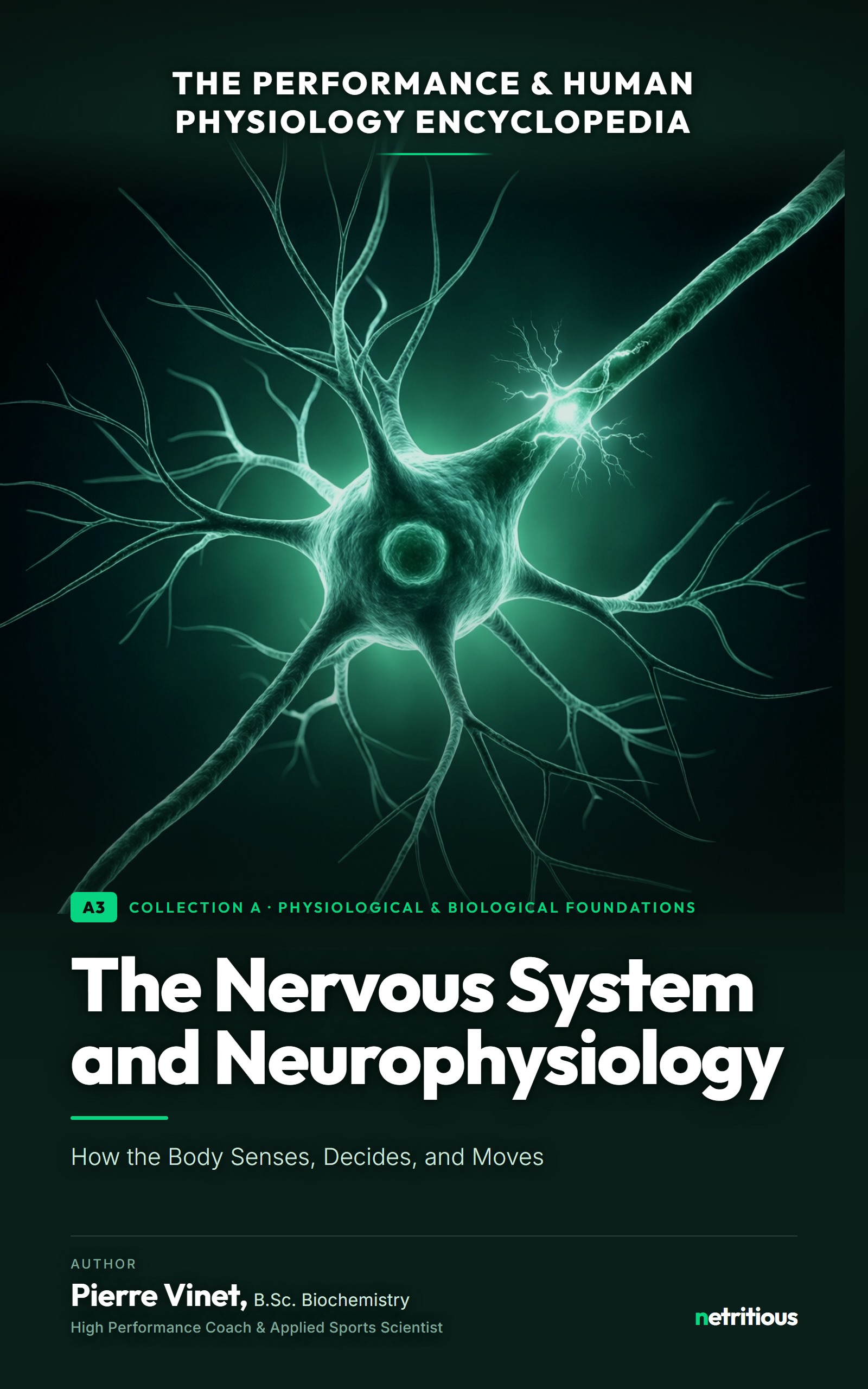
The Nervous System and Neurophysiology
How the Body Senses, Decides, and Moves
About this volume
The Nervous System and Neurophysiology is Book A3 of The Performance & Human Physiology Encyclopedia — a 93-volume, university-level library on how the human body actually works, system by system. It is written for students, coaches, clinicians and serious self-learners: deep enough that a professional already trained in the field keeps learning, structured clearly enough that a motivated reader can follow every step.
How this book is written
- University level, without dilution. Exact scientific terminology, defined at first use — mechanisms, not just conclusions.
- Evidence graded, not asserted. Major claims carry a level, from A (strong) to D (expert opinion), so you always know how much weight to give them.
- Numbers, formulas, worked examples. Reference ranges, equations and solved calculations you can apply the same day.
- Myths tested against the evidence. Where a popular claim does not survive the evidence, the book says so — and shows why.
- References at the end of every chapter. Sources cited in APA 7 style, plus a master bibliography.
For general information and education only; not medical advice. Consult a qualified health professional before acting on its content.
Read an excerpt
From Chapter 1 — The Nervous System: Organization and the Logic of Neural Control
"Every movement you make, every sensation you feel, every decision you reach, and every heartbeat that keeps you alive is a message passing through a network of cells that speak in pulses of electricity and whispers of chemistry. To understand the body, you must understand its wiring."
The nervous system is the master integrator of the body. Books A1 and A2 built the cell and explained how it powers itself; this book explains how billions of cells are coordinated into a single, responsive organism. That coordination is the difference between a pile of living tissue and you — a being that senses the world, learns, decides, and acts. Whether your goal is to lift a heavier weight, master a new skill, sharpen your focus, recover from a hard week, manage stress, or simply understand why a hot stove makes your hand jerk back before you feel the pain, the answer lies in neurophysiology. Strength itself is, in its first weeks, mostly a neural phenomenon — the muscle has barely changed, but the nervous system has learned to drive it harder (Chapter 12). Fatigue has a central component decided in the brain and spinal cord, not only in the muscle (Chapter 13). The "mind-muscle connection," reaction time, balance, the calm of a parasympathetic state, the racing heart of a sympathetic one — all are neurophysiology in action. This chapter lays out the map: what the system is built from, how it is organized, and the logic that governs everything that follows.
What is inside
The 13 chapters of this volume.
- 01
The Nervous System: Organization and the Logic of Neural Control
- 02
The Neuron and Neuroglia: Cellular Architecture
- 03
The Resting Membrane Potential: Ions, Gradients, and Electrochemistry
- 04
The Action Potential: Generation and Propagation
- 05
The Synapse: Signal Transmission Between Cells
- 06
Neurotransmitters, Receptors, and Neuropharmacology
- 07
Sensory Systems: Receptors, Transduction, and the Somatosensory World
- 08
Motor Systems: From Intention to Movement
- 09
The Motor Unit, the Neuromuscular Junction, and Excitation–Contraction Coupling
- 10
The Central Nervous System: Brain and Spinal Cord
- 11
The Autonomic Nervous System
- 12
Neuroplasticity, Learning, and Neural Adaptation to Training
- 13
The Nervous System in Practice: Performance, Fatigue, Recovery, and Brain Health
Volume details
Topics covered
- action potential and synapse explained
- neurotransmitters and receptors
- brain and spinal cord anatomy
- motor unit and neuromuscular junction
- sympathetic and parasympathetic autonomic control
- neuroplasticity and motor learning
- sensory receptors and perception
Get this volume
This volume is in production. This page will carry the link the day it goes on sale.