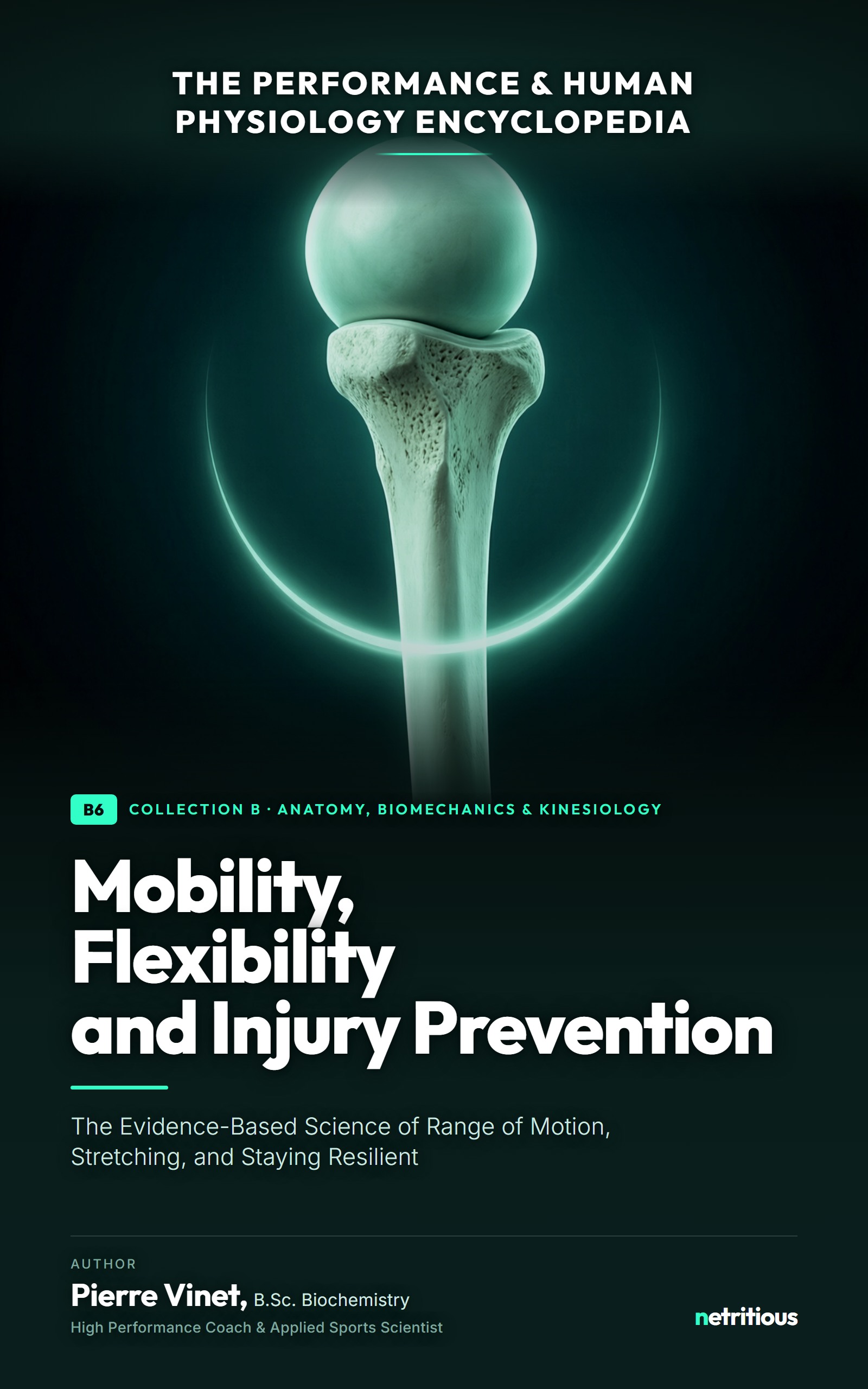
Mobility, Flexibility and Injury Prevention
The Evidence-Based Science of Range of Motion, Stretching, and Staying Resilient
About this volume
Mobility, Flexibility and Injury Prevention is Book B6 of The Performance & Human Physiology Encyclopedia — a 93-volume, university-level library on how the body produces, transmits and controls movement. It is written for coaches, strength athletes, physiotherapists and kinesiology students: deep enough that a professional already trained in the field keeps learning, structured clearly enough that a motivated reader can follow every step.
How this book is written
- University level, without dilution. Exact scientific terminology, defined at first use — mechanisms, not just conclusions.
- Myths tested against the evidence. Where a popular claim does not survive the evidence, the book says so — and shows why.
- References at the end of every chapter. Sources cited in APA 7 style, plus a master bibliography.
For general information and education only; not medical advice. Consult a qualified health professional before acting on its content.
Read an excerpt
From Chapter 1 — Introduction: Mobility, Flexibility, and Range of Motion
"Few topics in fitness are as cluttered with confident, contradictory advice as stretching and mobility. Touch your toes or you'll get hurt; stretch before you run; foam-roll away your knots; the more flexible the better. Most of it is folklore. This book replaces the folklore with evidence — and it begins by getting the words right, because 'flexibility,' 'mobility,' and 'range of motion' are not the same thing, and confusing them is where much of the bad advice starts."
Mobility and injury prevention are among the most practically relevant — and most misunderstood — areas of training and health. Getting the concepts right is the foundation for everything that follows: whether stretching helps performance (Chapter 6) or prevents injury (Chapter 7), what actually limits your range (Chapter 2), and how to build sensible mobility without chasing pointless extremes (Chapters 8, 13). This opening chapter defines the vocabulary precisely, dispels the "more flexibility is always better" assumption, and sets the evidence-based tone that distinguishes this book from the folklore that dominates the topic.
What is inside
The 13 chapters of this volume.
- 01
Introduction: Mobility, Flexibility, and Range of Motion
- 02
The Determinants of Range of Motion
- 03
The Science of Stretching: How ROM Increases
- 04
Neurophysiology of Stretch
- 05
Methods of Stretching
- 06
Stretching, Performance, and Warm-up
- 07
Stretching and Injury Prevention: The Evidence
- 08
Mobility Training and Self-Myofascial Release
- 09
Assessing Mobility and Flexibility
- 10
Region-by-Region Mobility
- 11
Flexibility Across Populations and the Lifespan
- 12
Injury Prevention: A Mechanical and Load-Based Framework
- 13
Applied Mobility and Injury Prevention
Volume details
Topics covered
- warm up before sport evidence
- foam roller benefits and limits
- hamstring strain prevention exercise
- stiff joints hips ankles shoulders
- static vs dynamic stretching
- sports injury risk factors
- hypermobility beighton score
Get this volume
This volume is in production. This page will carry the link the day it goes on sale.