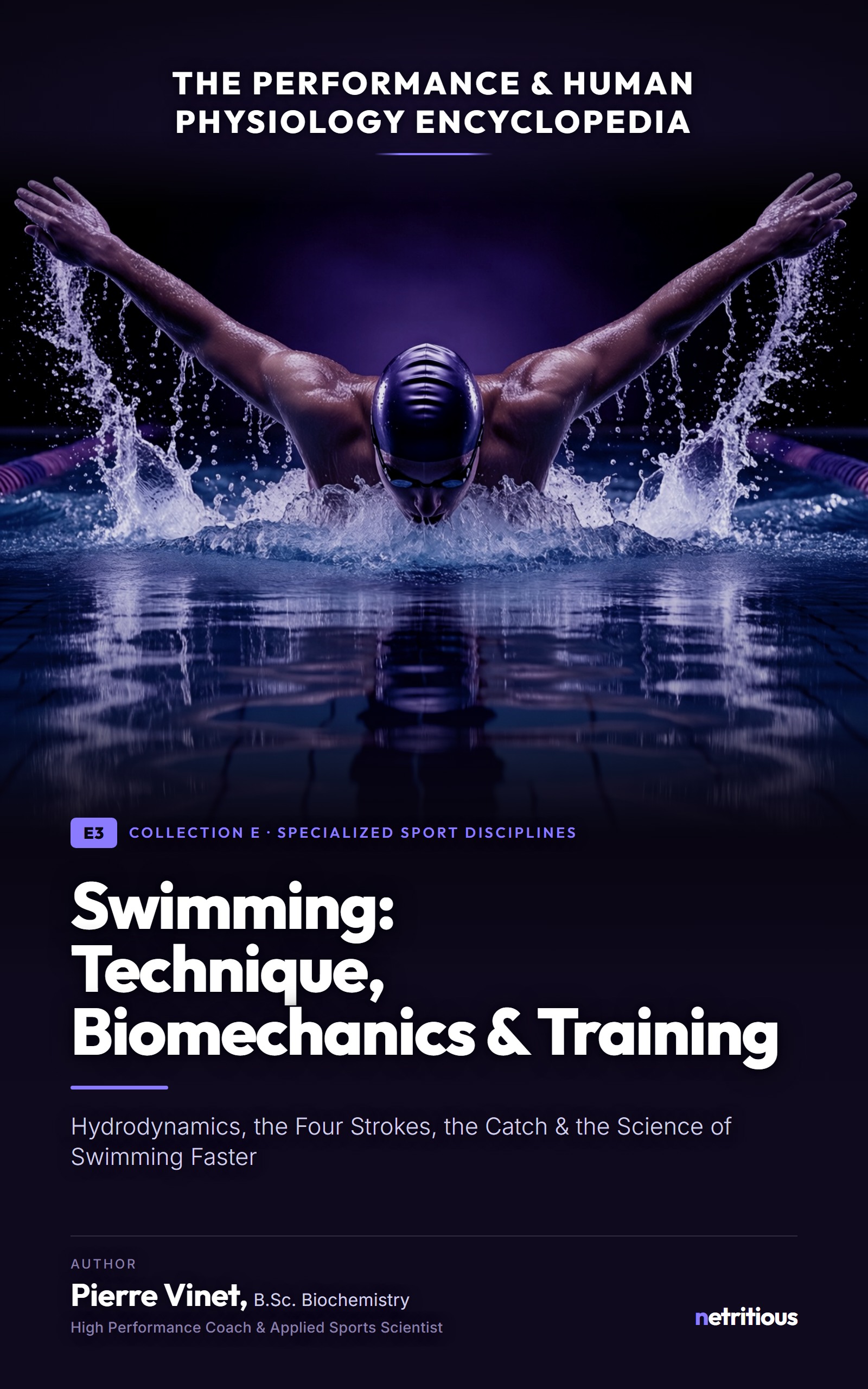
Swimming: Technique, Biomechanics & Training
Hydrodynamics, the Four Strokes, the Catch & the Science of Swimming Faster
About this volume
Swimming: Technique, Biomechanics & Training is Book E3 of The Performance & Human Physiology Encyclopedia — a 93-volume, university-level library on the physiology, technique and programming of a specific sport. It is written for competitive athletes and the coaches who prepare them: deep enough that a professional already trained in the field keeps learning, structured clearly enough that a motivated reader can follow every step.
How this book is written
- University level, without dilution. Exact scientific terminology, defined at first use — mechanisms, not just conclusions.
- Myths tested against the evidence. Where a popular claim does not survive the evidence, the book says so — and shows why.
- References at the end of every chapter. Sources cited in APA 7 style, plus a master bibliography.
For general information and education only; not medical advice. Consult a qualified health professional before acting on its content.
Read an excerpt
From Chapter 1 — What Makes a Swimmer Fast
"On land, you get faster mostly by producing more power. In water, you get faster mostly by losing less — because water is roughly eight hundred times denser than air, and it fights every centimeter you move. That single fact flips the whole sport: technique and streamlining matter more than raw fitness, and the fastest swimmers are the ones who waste the least."
Swimmers are flooded with technique tips, drills, gadgets, and training fads. The drag-first model is the framework that tells you what actually makes you faster (reduce resistance, then hold the water), what's a distraction, and where marketing oversells. Every later chapter plugs into it.
What is inside
The 13 chapters of this volume.
- 01
What Makes a Swimmer Fast
- 02
The Physics of Swimming (Fluid Mechanics)
- 03
Swimming Physiology & Energy Systems
- 04
Streamlining & Body Position
- 05
Propulsion & the Catch
- 06
The Four Strokes
- 07
Stroke Metrics: DPS, Stroke Rate & Velocity
- 08
Breathing, Turns & Starts
- 09
Training in the Water: Sets & Energy Systems
- 10
Dryland, Strength & Mobility
- 11
Periodization & Planning
- 12
Open Water & Common Issues
- 13
Putting It Into Practice
Volume details
Topics covered
- freestyle stroke efficiency
- flip turn and streamline
- swim drills for adults
- open water swim preparation
- distance per stroke
- critical swim speed pace
- triathlon swim coach
Get this volume
This volume is in production. This page will carry the link the day it goes on sale.